[Updated, Aug 2026]
Key Takeaways:
In 2024, GetSolar surveyed 101 Singaporeans on their electricity bills and habits — bigger, more premium homes paid roughly triple what a 1 to 2-room flat did, and air-conditioning and clothes dryers were the two biggest drivers of a high bill. Since then, SP Group's tariff has climbed to a record 34.78 cents/kWh in Q3 2026, so every dollar figure below is now a floor, not a current estimate.
Singapore's electricity tariff just hit a record high, and it's worth holding that up against what we found when we asked 101 Singaporeans about their bills back in 2024. From 1 July to 30 September 2026, SP Group's regulated household rate rose 17% to 34.78 cents per kWh (including GST) well above what our respondents were paying when we rant this survey. For the full breakdown of what's driving the increase, see our dedicated piece on the Q3 2026 tariff rise.
The survey below is from an earlier point in time, but it's still the most detailed look we have at how Singaporeans actually live with their electricity bills - what they paid, what drove the cost up, and how they felt about it. Comparing that against today's record tariff shows how much more those same habits cost now.
With Singaporeans having more say thanks to the open electricity market, we're curious to learn more. So, we reached out to 101 fellow Singaporeans to learn about their average electricity bills, lifestyle habits, and what they make of it all.
Note: This survey was conducted in April 2024. The dollar figures throughout reflect 2024 tariff rates and are due for a refresh - see the current Q3 2026 tariff (34.78 cents/kWh) above for what things cost today. The behavioural findings (how people use aircon, dryers, and track usage) still hold up well.
Average Monthly Electricity Bill In Singapore
The survey data provides a breakdown of the number of respondents within different ranges of electricity bill spending. To calculate the average spending, we sum up the total spending across all respondents in each spending range and then divide by the total number of respondents.
Average Electricity Bill By Household Type

We'll compare each average spending with the lowest average spending ($90.00, corresponding to 1-room and 2-room flats)
This breaks down the average household electricity bill in Singapore, and by extension the average electricity consumption per household, based on our 2024 reader survey.
The cost of electricity bills correlate to the size of a home, and how luxurious it is.
For example, executive maisonettes, semi-detached houses, and bungalows typically incur triple the electricity costs of 1 and 2-room flats. In comparison, condominiums have lower average bills than executive maisonettes, with costs averaging at $176.36 and $224.09, respectively. The difference in electricity costs are highly attributed to the fact that condos are generally smaller than executive maisonettes.
Other factors that could affect household electricity expenses could be simply using energy-efficient appliances or practising sustainable habits.
Bottom line: Even with the tariff up since 2024, bigger and more premium homes still pay roughly triple what a 1 to 2-room flat does.
Average Electricity Bill By Number Of Persons Residing In The Household

We'll compare each average spending with the lowest average spending ($82.00 for a 1-person household) and calculate the percentage difference.
As expected, electricity costs generally increase as more people live in a household, though the rate of increase doesn't move in a straight line.
For instance, the cost jumps significantly by 53.92% when moving from a 2-person household to one with 3 or 4 people. That increase eases to 23% when expanding from a 3 or 4-person household to one with 5 people, but it ticks back up to 28.36% as households expand beyond five members, likely reflecting the added consumption that comes with more occupants sharing a home.
This pattern indicates that while larger families do use more electricity, the incremental cost doesn't shrink steadily as household size grows. It eases in the mid-range before rising again for the largest households.
Bottom line: More people generally means a higher bill, but the cost per additional person doesn't fall in a straight line it eases before ticking back up for the largest households.
Does Your Choice Of Electricity Retailer Make A Difference?
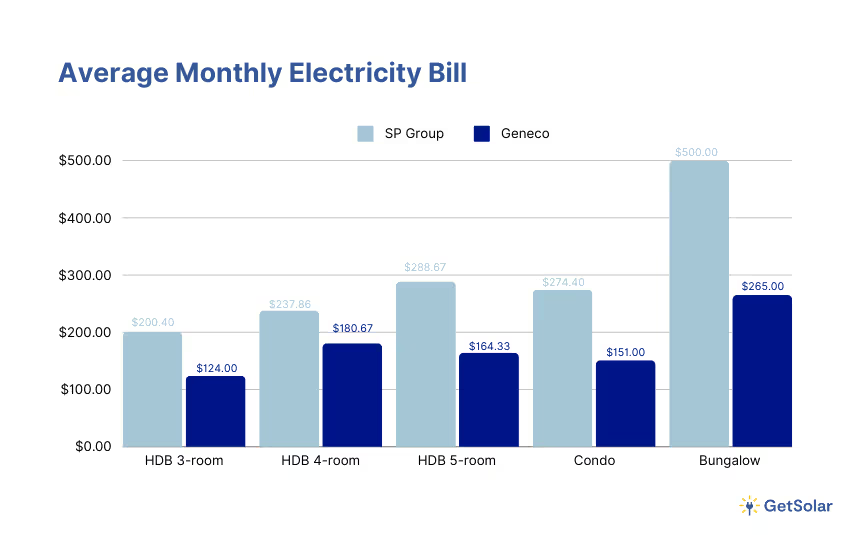
From a survey of 101 participants, 61 (about 60.4%) use SP Group, while 17 (16.8%) are with Geneco. The rest are distributed among various other retailers.
Notably, Geneco users reported lower average electricity costs than those with SP Group. In the second quarter of 2024, for instance, Geneco's rate was 28.98 cents/kWh for a 12-month contract, which undercut SP Group's rate of 31 cents/kWh at the time. This pricing difference likely contributed to the trend observed.
If you're looking to reduce your electricity bills or considering a switch, check out our updated guide on the best electricity plans in Singapore.
Bottom line: Retailer choice made a real difference even in 2024. With Q3 2026's tariff, switching off the regulated rate is worth revisiting.
Other Factors Influencing Electricity Costs
Air Conditioning Usage

The data from these charts clearly show that air conditioning is a significant driver of higher electricity bills. Households with 3-4 people tend to use air conditioning for extended periods, often between 7-9 hours, compared to those with five or more people.
This pattern suggests that 3-4 person households might run their air conditioning for longer periods compared to larger households in Singapore. This could be due to greater personal space and the ability to individually control the temperature in separate rooms, but also raising electricity costs.
Bottom line: Aircon remains the single biggest electricity consumer most Singapore households have on their bill, and with the tariff up 17% since this survey, that habit costs more than it did in 2024.
Usage Of Energy Efficient Appliances

In executive maisonettes, 45.5% of households use appliances rated with three NEA energy efficiency ticks, 36.4% with four ticks, and 18.2% with five ticks. Condominiums show similar trends, with 9.1% using two-tick appliances, 45.5% with three ticks, 36.4% with four ticks, and another 9.1% with five ticks.
This data suggests that residents of larger living spaces are more energy-conscious. The higher electricity usage that typically comes with large living spaces likely motivates the choice of switching to energy-efficient appliances.
Specifically for 4-room HDB with 3-4 occupants, a comparison between 3-tick and 5-tick appliances reveals significant differences in energy efficiency.
Households using 3-tick appliances have an average monthly electricity bill of $220.63, whereas those with 5-tick appliances spend only $151 on electricity. This results in monthly savings of about $69.63 by opting for more energy-efficient 5-tick appliances.
Bottom line: Upgrading from 3-tick to 5-tick appliances saved 2024 respondents about $69.63 a month. With today's higher tariff, that gap is worth more.
Dryer Machine Usage

Although air conditioning is a known contributor to their monthly expenses, the primary factor driving up the electricity bill is a clothes dryer, despite their convenience. Fortunately, 68.3% of respondents do not own this heavy consuming appliance.
Appliances that generate heat, such as clothes dryers, typically use more electricity than those designed to cool, a pattern also borne out in broader industry analysis from Renewable Energy World.
Bottom line: A single heat-generating appliance like a dryer can outweigh aircon as the biggest line item on your bill, worth checking before you assume aircon is always the top culprit.
Awareness Of Electricity Consumption
Trends In Household Electricity Monitoring

Approximately 90% of respondents monitor their household electricity consumption through monthly bills, while the remaining 10% leverage technology to track real-time usage. Examples of these tracking systems are smart meters and mobile apps like the SP Group App.
These findings indicate a growing trend towards awareness and proactive management of electricity usage in homes. This also suggests that more households are becoming interested in tools that offer detailed and immediate feedback on their energy patterns, as compared to monthly bills.
Bottom line: Most Singaporeans still only check their usage once a month, on the bill itself.
Adoption Of Energy-Saving Strategies

The trend in this section displays the energy-saving methods adopted by homeowners. 43% of these individuals are taking further steps by investing in energy-efficient LED bulbs and adjusting thermostat settings. This highlights the collective effort toward reducing electricity consumption and promoting sustainability within households.
Bottom line: Under half of respondents had taken active energy-saving steps beyond the basics - there's still plenty of room for straightforward savings most households haven't captured yet.
How To Further Save On Your Monthly Utility Bills

Around 38% of the respondents expressed that Singapore electricity bills are expensive. Among these individuals, approximately 61% indicated they would consider switching to renewable energy sources if they were more accessible and affordable.
This suggests a significant relation between the perceived cost of electricity bills and the willingness to adopt renewable energy alternatives.
Bottom line: Six in ten Singaporeans who found their bills expensive in 2024 were already open to renewables, with the tariff up 17% since then, that interest is likely stronger now.
Install Solar Panels On Your Roof
As such, switching to solar could be a game-changer, especially on your electricity bills. Having solar panels on your roofs in sunny Singapore allows you to generate your own electricity instead of having to fully depending on the grid.
You could significantly cut your electricity bills and in some cases, even see your electricity provider pays you.

This is just one example of how solar can impact your life, read our article on the benefits of solar panels for even more goodies that come with installing solar panels!
Price of Solar Panels
You may be concerned about the hefty price that comes with solar panels. Fret not, the prices for solar panels have significantly dropped by 89%, making solar significantly more affordable than a decade ago.

Furthermore, here at GetSolar, we're committed to making solar way more affordable and accessible. That's why we offer the Rent-to-Own programme, removing the need for high upfront costs. You pay S$0 upfront, with repairs and maintenance included for the life of the system.
Methodology
We gathered our data through a Google survey conducted among residents in Singapore. The distribution of the survey primarily relied on word-of-mouth referrals and sharing within appropriate social groups on platforms like WhatsApp and Telegram.
Survey Respondents' Demographic Profile
Age Distribution
The survey findings reveal a notable diversity in the age distribution of respondents, painting a vivid picture of electricity consumption habits across different life stages. More than half of the respondents (52.5%) were in the age bracket of 25 to 34 years old; Additionally, 11.9% of respondents were aged between 35 and 44, while 13.9% were in the 45 to 54 age range.
Household Type
The survey findings reveal a varied distribution of respondents across different types of housing in Singapore. Among the respondents, 29.7% lived in 4-room HDB flats, making it the most common housing type represented in the sample. Following closely behind, 21.8% of respondents resided in 5-room HDB flats, while 10.9% lived in executive maisonettes and another 12.9% in 3-room HDB flats. Additionally, 10.9% of respondents lived in condominiums, adding to the diversity of housing types in the survey sample.
Number of People Residing in the Household
The survey reveals diverse household sizes among respondents, reflecting various living arrangements in Singapore. The majority of respondents, comprising 53.5%, lived in households with 3 to 4 members. Additionally, 15.8% of respondents resided in households with 5 members, while another 12.9% lived in households with 2 members. Interestingly, an equal percentage of respondents, also 12.9%, reported living in households with more than 5 members, showcasing the range of household sizes represented in the survey sample.
Bottom line: This 2024 sample skewed toward 25-34 year-olds in 3 to 4-person, 4-room HDB households.
Frequently Asked Questions
How much do Singaporeans typically spend on electricity?
Our 2024 reader survey found that a 1 to 2-room flat spent around $90 a month on average, rising to roughly triple that for executive maisonettes, semi-detached houses, and bungalows. Since then, SP Group's tariff has risen to 34.78 cents/kWh in Q3 2026, so current bills will run higher than these 2024 figures.
What's the biggest factor driving up an electricity bill in Singapore?
Air-conditioning, based on both our survey and general usage patterns - though our respondents also found that clothes dryers, where owned, could outweigh aircon as the single biggest line item.
Does switching electricity retailers actually save money?
Yes, based on our 2024 respondents - those with Geneco reported lower average costs than those on SP Group's regulated tariff at the time. With Q3 2026's tariff rates, comparing Open Electricity Market plans is worth revisiting.
How many Singaporeans think their electricity bills are too expensive?
38% of our 2024 survey respondents said so, and of those, 61% said they'd consider switching to renewable energy if it were more accessible and affordable.
Is this survey data still accurate in 2026?
The behavioural findings - how people use aircon, dryers, and track usage - hold up well over time. The dollar figures are tied to 2024 tariff rates and are due for a refresh.
Conclusion
Two years on, the questions this survey set out to answer are more relevant than ever. Singapore's electricity tariff just hit its highest point on record at 34.78 cents/kWh, and EMA has flagged that Q4 2026 could move either way depending on global fuel prices.
Whether you're in a 3-room flat or a landed home, the habits our respondents described are probably still relevant today. The one move that removes the tariff from the equation entirely is generating your own electricity.
Try our free solar calculator to see exactly what solar could save you at today's rates, or simply chat with one of our solar advisors for more information!

Rent-to-Own Solar for Business with Guaranteed Performance
Immediate ROI



Rent-to-Own Solar. $0 Upfront cost. Guaranteed Savings
(10-Year RTO plan)
+ 10-Year Free Maintenance

Be part of The Solar Collective, where we share the latest updates, tips, and discussions on solar energy.