[Updated, September 2026]
Key Takeaways:
Solar power roof tiles cost roughly two to three times what conventional panels cost per unit of output. Building-integrated photovoltaics (BIPV), including solar tiles, do exist in Singapore, but they're specified at the architectural stage on new builds, not retrofitted onto an existing roof.
If you've searched for solar roof tiles, solar shingles, or the Tesla Solar Roof, you're probably asking one of two things: can I get them in Singapore, and are they worth it?
Short answers: Tesla's product, no. Solar tiles more broadly, technically yes but rarely, and probably not for your roof. This guide explains why, what integrated solar actually costs, and what to do if your real concern is that panels will spoil the look of your house.
Can You Get Solar Roof Tiles in Singapore?
Tesla Solar Roof is not sold in Singapore and never has been. Tesla Singapore sells vehicles and Powerwall home batteries only, and there's no announced plan to bring Solar Roof here.
Solar tiles and BIPV more broadly do exist in Singapore, but as architectural products rather than consumer ones. The Solar Energy Research Institute of Singapore (SERIS) at NUS runs a BIPV Centre of Competence that test-beds building-integrated PV in tropical conditions. A handful of local firms build integrated systems; SolarGy is the best-known, and appears in our ranking of solar companies in Singapore.
What you won't find is a solar tile product you can quote, order and retrofit onto an existing landed home. Integrated solar here is something an architect specifies at design stage on a new build or full rebuild.
Aesthetics
This is the only category where tiles genuinely win, and it's why most people search for them.
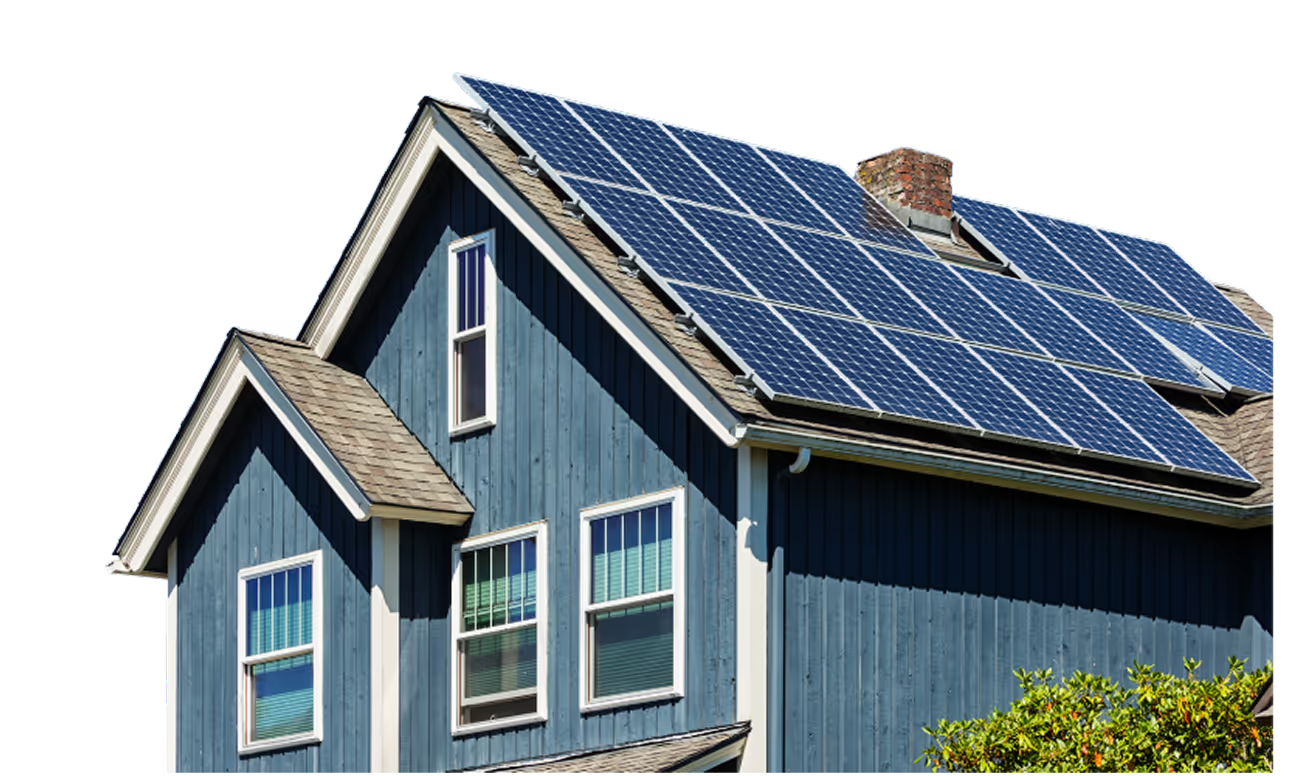
Conventional panels have a recognisable look: a blue or black rectangle sitting several inches above the roofline on visible racking, with some exposed conduit. Solar tiles are designed to disappear. Tesla's shingles come in textured, smooth, Tuscan and slate finishes, with no racking and no visual break between solar and non-solar tiles. From the ground you generally can't tell which is which. If a seamless roofline matters more to you than payback period, that's a real advantage.
The gap has narrowed, though. All-black monocrystalline panels on low-profile mounting look far better than the panels people picture when they imagine rooftop solar — more on that below.
Efficiency and Roof Space
Singapore landed roofs aren't large, so efficiency per square metre is the binding constraint.
Tesla's shingles produce around 70W each, against 400–600W for a modern panel. On a terrace or semi-detached roof, that gap often means an integrated system can't be sized to offset a meaningful share of your bill.
Laboratory tests on BIPV tiles report efficiencies approaching 19.5%, but Singapore field verification in tropical heat and humidity remains limited. Panel performance here is documented across thousands of local installations. For a breakdown of the technologies, see our guide to the types of solar panels available in Singapore.
Installation Reality
Conventional panels mount onto what's already there. Tiles are lifted so a mounting frame can be secured, then replaced; metal and concrete roofs often need no drilling. The job takes one to three days. The main variables are scaffolding (S$2,000–S$6,000 if there's no direct roof access) and waterproofing on older roofs. Our roof support and BCA approval guide covers the structural side.
Solar tiles require your entire roof to come off and be rebuilt: weeks rather than days, weather exposure during the works, and far more complexity on roofs with dormers, valleys or unusual pitches. The contractor pool is tiny, single digits in Singapore.
What Solar Roof Tiles Cost
No installer publishes a Singapore price, because none offers solar tiles as a standard retrofit. The nearest reference points come from the US, where Tesla actually sells the Solar Roof.
Tesla's estimates put a roughly 148 m² roof at US$54,000–US$58,000, or about US$3.78–4.05 per watt. One larger completed installation ran US$176,600 for 772 m², plus US$26,600 to demolish the existing roof. Independent analysis puts the Solar Roof at up to 75% more expensive than panels for equivalent output, and Tesla requires at least one Powerwall on top, adding roughly US$10,500.
A conventional system on a Singapore landed home runs:
Full breakdown in our solar panel installation cost guide.
The gap matters more in 2026 than it used to. SP Group's regulated tariff hit a record 34.78¢/kWh in Q3 2026, a 17% jump driven by gas prices. Every month you spend not generating is a month at that rate. A system that costs three times as much and produces less pushes your payback period from five to eight years out past the point where the maths works.
When Solar Tiles Actually Make Sense
Three cases, and they are narrow:
- You're reroofing anyway. If your roof is at end of life and you're already budgeting for a full replacement, you're not paying for solar plus a roof, just the difference between a conventional new roof and a solar one.
- You're building new with an architect engaged. BIPV is a design decision, not a retrofit. If your architect is specifying the envelope now, the structural and waterproofing detailing gets designed in rather than bolted on.
- You have a genuine design constraint. Conservation properties, GCB guidelines, or a design review that won't accept visible racking. If a panel array won't be approved, integrated solar may be your only route to generating on-site.
For the overwhelming majority of Singapore landed homeowners, none of these apply. Panels are the better decision.
Tesla Solar Roof: What It Is, and Why It Isn't Here
Tesla entered solar through its 2016 acquisition of SolarCity and announced the Solar Roof in 2017. The product combines glass photovoltaic tiles with matching non-solar tiles into a single roof surface, in four finishes designed to pass for conventional roofing.
It hasn't reached Singapore mostly because of scale. Deployment ran at roughly 23 roofs per week in Q2 2022 against a stated goal of around 1,000. A product at that volume doesn't expand into a market our size, where the addressable base is landed homeowners rather than the whole housing stock.
The track record matters too. In 2021 Tesla raised pricing on customers who had already signed contracts, by 30% to 150% depending on a "roof complexity" factor, and told them to accept or cancel. Installations then paused several times through 2022 on supply chain grounds, in some cases leaving customers with temporary waterproofing on an unfinished roof for months.
Marques Brownlee's video walkthrough of his own Solar Roof is the most useful consumer account available.
If You Want Solar That Doesn't Look Like Solar
Most people searching for solar roof tiles aren't shopping for a specific product. They want solar without the roof looking industrial. That's solvable without integrated tiles.
- All-black panels. Black cells, backsheet and frame. Against a dark tiled or metal roof they read as a flat dark surface rather than a grid of blue rectangles, and the efficiency penalty is marginal.
- Low-profile mounting. Rail systems that sit the array closer to the roof plane cut the "bolted-on" impression, particularly on pitched roofs seen from street level.
- Layout planning. Align the array to the roof's edges, keep it rectangular, avoid stray panels stranded around vents and skylights, run conduit internally where possible. A layout designed with the elevation in mind looks nothing like one that just maximises panel count.
- Choosing the right roof plane. On many landed homes the rear or side pitch has near-identical irradiance to the front and is invisible from the street. Our buyer's guide covers how to evaluate this.
One more thing: panels come off. If you sell, reroof, or change your mind, a mounted array can be removed and reinstalled. A solar roof is your roof. See what happens to solar panels when you sell your home.
The Practical Alternative
If the barrier is upfront cost rather than aesthetics, GetSolar's Rent-to-Own plans start from S$210/month with zero upfront on the ten-year plan, or S$160/month on the five-year plan with around 50% upfront. Installation, maintenance and repairs are included for the plan term. If you're weighing that against financing a purchase, our solar loan vs. Rent-to-Own comparison runs the 25-year numbers.
Check out our free solar calculator to calculate your potential roof savings, or chat with our solar advisors for a no-obligation assessment.
FAQs
Can I Buy a Tesla Solar Roof in Singapore?
No. Tesla Singapore offers vehicles and the Powerwall home battery only, and there is no announced plan to bring Solar Roof here.
How Much Do Solar Roof Tiles Cost in Singapore?
No installer publishes a price, because solar tiles aren't sold here as a standard retrofit product. Based on US pricing for the Tesla Solar Roof, an equivalent integrated system would run roughly two to three times the cost of conventional panels.
Are Solar Roof Tiles More Efficient Than Solar Panels?
No. Tesla's shingles operate at around 17–20% efficiency against 19–23% for Tier-1 monocrystalline panels, and each shingle produces roughly 70W against 400–600W per panel. On a space-constrained Singapore roof, that difference is decisive.
Can Solar Panels Be Installed on a Clay or Concrete Tiled Roof?
Yes. Tiles are typically lifted so a mounting frame can be secured to the structure beneath, then replaced. Drilling is usually required, so waterproofing should be checked beforehand — particularly on older roofs.
Are Solar Roof Tiles Worth It for a Landed Home in Singapore?
For most homeowners, no. The premium isn't recoverable through energy savings, and the product isn't readily available. The exceptions are homeowners already committed to a full reroof, new builds where an architect can specify BIPV at design stage, and properties under design restrictions that rule out visible racking.
What Is BIPV?
Building-integrated photovoltaics: solar materials that replace conventional building elements rather than sitting on top of them. Solar roof tiles are one form; PV curtain walls, facade cladding and semi-transparent glazing are others. In Singapore it remains a specialist architectural product rather than a consumer one.

Rent-to-Own Solar for Business with Guaranteed Performance
Immediate ROI



Rent-to-Own Solar. $0 Upfront cost. Guaranteed Savings
(10-Year RTO plan)
+ 10-Year Free Maintenance

Be part of The Solar Collective, where we share the latest updates, tips, and discussions on solar energy.


.png)