[Updated: June 2026]
Key takeaways:
Solar installation for Singapore landed homes ranges from S$8,000 to S$38,000 depending on property type, roof material, and system size, but typically offsets 50–80% of monthly electricity bills to yield over S$50,000 in savings across 25 years. With a 5–8 year payback period, homeowners can further optimise returns by earning grid credits via the SCT scheme, while standard annual maintenance fees of S$300–S$500 can be completely bypassed using GetSolar’s Rent-to-Own plans.
Did you know that the price of solar panels in Singapore is actually reasonable? Solar panel installation prices, in the past 10 years, have fallen by a whopping 89%!
That said, solar panel prices can vary with the roof, type of solar panel, and more. Opting for either a traditional upfront purchase, or $0 upfront cost offers which can only be found at GetSolar, also affect the price of your solar panel installations in Singapore.
This guide breaks down what you'll actually pay — for installation, for any waterproofing work your roof needs, and for maintenance over the life of your system.
How Much Does It Cost to Install Solar Panels in Singapore?
Here’s an estimate of the standard solar panel installation prices for landed homes in Singapore. Remember that installation costs also vary dependent on your roof type.
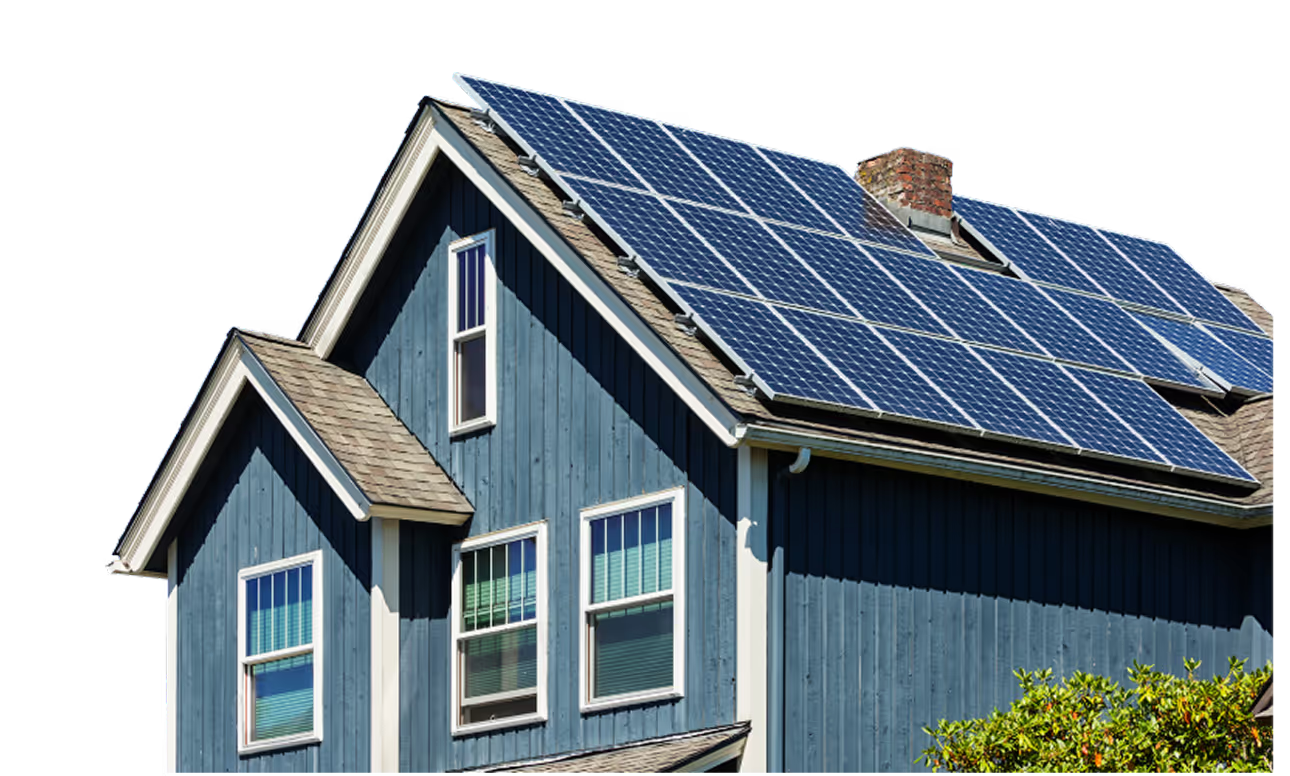
Terrace Houses: A typical system runs 12–20 panels at 5–8 kWp, generating around 600–960 kWh per month. Total installed cost ranges from S$8,000–S$16,000 depending on system size and roof type.
Semi-detached Houses: You can usually fit 20–30 panels, or an 8–12 kWp system, generating 960–1,440 kWh per month. Expect to pay S$13,000–S$24,000 fully installed.
Bungalows: With more roof space, most bungalows can accommodate 30–55 panels at 12–22 kWp, generating 1,440–2,640 kWh per month. Total installed cost typically runs S$20,000–S$38,000.
GetSolar’s Solar Panel Price Plans
Finally, what determines the price of your solar panel installation would be the pricing plans you choose to go with.
While most solar panel companies in Singapore only offer upfront purchase models, GetSolar provides additional options for customers to finance their solar panel systems over five years as well as ten year plans.
The main difference between 10-year plans and 5-year plans are mainly the proportion of upfront costs required to be paid, as well as the length of workmanship warranty attached, which comes with complimentary servicing and free maintenance. 5-year plans come with a 50% upfront cost, as well as shorter workmanship warranty, but are cheaper overall compared to 10-year plans, which have a longer time horizon.
Determining what is for you ultimately depends on your priorities: whether you value the complimentary protection that comes with the length of the plan, or if you prefer to have a more economical purchase overall.
Ready to see the exact breakdown for your home? Estimate your ideal system size, upfront costs, and monthly savings in under a minute.
What Is Included in the Cost of Solar Panel Installation?
A fully installed quote from a reputable installer covers more than just the panels. Here's what you're paying for:
A Licensed Electrical Worker (LEW) must sign off on every grid-connected system in Singapore. Confirm this is included in your quote before signing.
How Much Can I Save With Solar Panels in Singapore?
A 10 kWp landed system generates 1,200–1,500 kWh/month — enough to offset 50–80% of a typical landed electricity bill. Singapore's electricity tariffs have surpassed 32.57 cents/kWh as of mid-2025 and continue rising at 3–5% annually.
Singapore has two schemes that credit you for excess electricity exported to the grid:
Simplified Credit Treatment (SCT): For SP Group customers. Excess solar is credited at roughly 75–80% of the prevailing tariff (around S$0.22–S$0.26/kWh today).
Enhanced Central Intermediary Scheme (ECIS): For Open Electricity Market retailer customers. Excess solar is credited at the wholesale market price, typically lower than SCT.
For most landed homeowners, payback runs five to eight years. Homes with high consumption and a well-oriented roof can reach break-even in as little as three to four years. Over the full 25-year system lifespan, total savings typically reach S$50,000+.
If you're ready to see how these numbers apply to your own roof, you can skip the manual math and use our Interactive Solar Calculator to get a personalised savings and payback estimate in seconds.
For a deeper look at payback scenarios, see our Solar Panel System Cost Guide for Singapore (2026).
What Factors Affect the Cost of Solar Panel Installation in Singapore?
Two systems on two different homes can produce very different quotes. Here's what affects the price of solar installation in Singapore.
Size Of The System

The first factor which affects the price of your solar panel installation would be, of course, the size of your system. The size of your solar panel system is limited by the available installation area on your roof, and while a larger system will cost more in total, its unit cost per kilowatt-peak (kWp) will be lower and more cost-effective.
The size of your solar panel system is also dependent on the amount of electricity you will need to generate to meet your household needs. For this, we recommend getting an estimate of your average electricity consumption based on your electricity bills from at least the past 3 months to get a good gauge.
You can also sell any excess electricity back to the grid in Singapore, so maximising your roof space makes sense even if you don't use all the power you generate.
Roof Pitch, Type And Material

Solar panels can be installed on almost all roofs. That said, there are certain roof types that require additional materials for installation, such as racking and mounting systems. Meanwhile, your roof's material will determine the mounting mechanisms needed for your installation. In Singapore, roofs are usually tiled, metal or concrete.
Tiled Roofing
Tiles are usually first removed for the installation of a mounting frame before being returned to their original spots. Solar panels are then fixed onto the mounting frame after. For tiled roofs, drilling is usually necessary to ensure that the mounting frame is properly secured. Also, if there is no direct access to your roof, scaffolding might be required which can add more costs, which can range from SGD $2,000 to $6,000 in total.
Metal Roofing
There are two main types of metal roofs used in Singapore – standing seam metal, and trapezoidal metal roofs. Standing seam metal roofs are the best roofs for solar, as no drilling or penetration is required and mounting clips can easily be fastened to the seams of your roof. This simple installation process also helps to reduce costs, and eliminate any risks of waterproofing concerns. It also means that your solar panels can be easily removed from your roof should you need to do so.
Concrete Roofing
Concrete roofs are straightforward for solar installation too. Mounting racks for solar panels are secured and weighed down by concrete ballasts on the roof, and similarly does not require any drilling or penetrations. As concrete roofs are often flat, the mounting racks are tilted for solar panels to be "self-cleaning" when it rains.
Note: For steep roofs, a longer installation process is often to be expected. This is because installers have to be extra meticulous to ensure that your solar panels are safely and securely attached to your roof. Steep pitches will also often require extra manpower, resulting in additional labour costs and an increased solar panel installation price.
Type Of Solar Panels
The type of solar panels you use also determine the price of your solar panel installation. Two main factors determine the price of solar panels — their technology and the brand. There are 3 main solar panel technologies: Monocrystalline, Polycrystalline and Thin Film.
While each has its pros and cons, monocrystalline solar panels are now the most frequently used for residential rooftop solar installations because they are the most space-efficient and have the highest efficiency.
Most solar installers in Singapore usually recommend panels made by “Tier 1” solar panel manufacturers. This tiering system was highlighted by Bloomberg New Energy Finance as a measure of a manufacturer’s reliability and consistency. Among “Tier 1” solar panels, their prices vary based on where they are manufactured, their efficiency and warranty durations.
The most popular solar panel brands used by installers in Singapore are Jinko, Trina, JA Solar and REC.
Wondering what your roof's actual solar potential is? Instantly map out your ideal system size here
Are There Government Incentives for Installing Solar Panels in Singapore?
Singapore does not offer direct cash rebates for residential solar installations. However, two grid export schemes let you earn credits for surplus electricity:
Simplified Credit Treatment (SCT): Available to SP Group customers. Credits surplus solar at roughly 75–80% of the prevailing tariff rate.
Enhanced Central Intermediary Scheme (ECIS): Available to Open Electricity Market customers. Credits surplus solar at the wholesale market price (USEP), which fluctuates and is typically lower than SCT.
In practice, SCT is the more predictable and popular choice for residential installations.
For a full breakdown of both schemes, see our guide to financial incentives for solar in Singapore.
Waterproofing and Reroofing: The Additional Cost to Budget For

Water intrusion may occur after installing your solar PV system. The installation process for tiled roofs may require drilling to set up rails that hold your solar panels. These drilled holes may result in rainwater accumulation that can cause leakages.
If your roof is relatively old or poorly maintained, we advise waterproofing your roof before you begin installing solar panels. After all, your solar panels are likely to sit on your roof for the next 25 to 30 years. Waterproofing procedures will add to your budget. However, they are a worthy investment to prevent any possible leakages after installation.
Need to repair your roof before your solar panel installation? Here’s a list of the 11 Best Roof Work Contractors in Singapore for you to refer to!
FAQs About Solar Panel Installation Costs
Are solar panels worth it in Singapore?
Yes, for landed homeowners. A well-sized system offsets 50–80% of your electricity bill, pays back in 5–8 years, and generates free electricity for the remaining 17–20 years of its 25-year lifespan.
How long do solar panels last?
Most solar panels are rated for 25–30 years. Performance warranties guarantee at least 80% output at year 25. Inverters typically last 10–15 years and may need replacement once during the system's lifespan.
Are there financing or payment plans available?
Yes. Solar providers like GetSolar offer a ten-year Rent-to-Own plan from $210/month with $0 upfront, and a five-year plan from $160/month with around 50% upfront.
Do solar panels come with a warranty?
Yes. Panels carry a 12-year product warranty and 25-year power output warranty. Inverters typically come with a 5-year warranty, extendable for an additional $300–$800. GetSolar's Rent-to-Own plans include a workmanship warranty and performance guarantee for the full plan duration.
Do I have to pay for maintenance?
The first 1–2 years are covered under the Defects Liability Period. On GetSolar's Rent-to-Own plans, maintenance is included for the full term at no additional cost.
Are there hidden costs associated with installing solar panels?
The main additional costs to budget for are scaffolding, roof waterproofing if your roof is older or tiled, and inverter warranty extensions. A reputable installer will itemise all of these in your quote.
Ready to See What Solar Costs for Your Home?
Use our free solar calculator for a personalised estimate, or chat with our solar advisors for a no-obligation assessment.

Rent-to-Own Solar for Business with Guaranteed Performance
Immediate ROI



Rent-to-Own Solar. $0 Upfront cost. Guaranteed Savings
(10-Year RTO plan)
+ 10-Year Free Maintenance

Be part of The Solar Collective, where we share the latest updates, tips, and discussions on solar energy.