Key Takeaway:
A 10 kWp landed home solar system in Singapore now pays back in 4 to 8 years, and that window is shrinking as SP Group's tariff climbs. At Q3 2026 rates of 34.78 cents/kWh, a S$15,000–S$20,000 system saving S$200–S$300 a month clears its cost faster than it did a year ago. Rent-to-Own skips the payback question entirely by starting your savings from month one at zero upfront cost.
5 years, 7 years, or 10 years? How long does it really take to pay for your solar system? Payback period depends on your system size, how much of what you generate you actually use, and what SP Group charges you per kWh.
If you're a homeowner considering solar, the real question isn't whether solar pays for itself. It's how fast you can pay off your solar system.
This guide will detail system cost, self-consumption savings, export credits under the Simplified Credit Treatment (SCT), and a worked example showing how Q3 2026's record tariff rate has significantly reduced payback periods across Singapore.
What Determines Your Solar Payback Period?
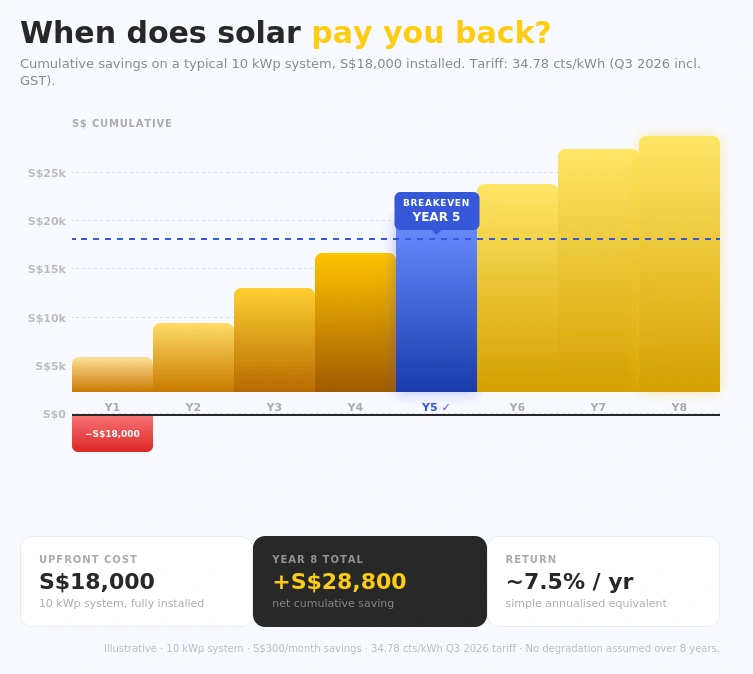
Payback period is calculated by dividing your system cost with your annual savings. Four factors decide your number.
System size and cost: A 10 kWp system for a typical landed home runs S$15,000–S$20,000 installed. Bungalows with more roof space can typically fit 12–22 kWp at S$20,000–S$38,000.
Self-consumption rate: Every kWh you use directly is worth the full retail tariff you'd otherwise pay SP Group — 34.78 cents/kWh, per SP Group's current tariff rates. Every kWh you export is worth less.
Export credit rate: Under the Simplified Credit Treatment scheme set out in the Energy Market Authority's (EMA) payment rules, SP Group credits your exports at the regulated tariff minus a grid charge of about 6.55 cents/kWh, working out to roughly 25–26 cents/kWh at current rates.
Your usage pattern: Homes that run air-con, pool pumps, or EV charging during daylight hours derive more value from every panel installed.
How Much Does a Solar System Cost in Singapore in 2026?
Cost scales with roof size, but its not linear. Larger systems cost more in total and less per kWp, since fixed costs like scaffolding and the SP Group application spread across more capacity.
Sources: GetSolar Singapore cost guides (2026)
Cost per kWp falls as system size grows, but payback period doesn't always correspond with it. It depends on how much of that extra capacity you actually use or export, not just how big the system is.
Payback Calculations: A Worked Example
Take a typical 10 kWp landed home system. At current pricing, that's S$15,000 on the low end and S$20,000 on the high end. Monthly savings from self-consumption plus export credits run S$200–S$300, depending on how much of your usage overlaps with daylight hours.
The gap between 4 and 8 years comes down to two things: how much you paid per kWp, and how much of your solar you use directly instead of exporting it.
Self-Consumption vs Export: Which Speeds Up Payback Faster?
Self-consumption wins, every time. A kWh you use directly saves you 34.78 cents. The same kWh exported under SCT earns you roughly 25–26 cents. That gap of about 9 cents per kWh proves that oversizing a system purely for export rarely improves payback.
Shift high-load appliances into daylight hours. Running air-con, laundry, or charging an EV while your panels are producing captures the full retail rate instead of the lower export rate. Our guide on how to save electricity in Singapore breaks down which habits help you save the most on your electricity bills.
If you're on an Open Electricity Market retailer instead of SP Group, you're on the Enhanced Central Intermediary Scheme (ECIS) instead of SCT, and your export credit tracks the wholesale USEP rate rather than a fixed quarterly number. Our USEP price guide walks through when that volatility works in your favour.
How Rising Tariffs Is Reducing Solar Payback Periods
Solar payback is reduced significantly every time SP Group's tariff rises, because the same system now offsets more expensive electricity without costing you a cent more.
That 17% increase from the 30 June 2026 tariff revision means a 10 kWp system generating the same output now saves more per month than it did three months ago. Payback periods calculated on last quarter's tariff are already out of date.
For more on solar export economics, see our electricity saving and sell-back guide.
Rent-to-Own: Skipping the Payback Question Entirely
Payback period only matters if you're paying upfront. GetSolar's Rent-to-Own (RTO) plan removes that calculation completely with zero upfront cost, a fixed monthly fee typically lower than your current SP Group bill, and full ownership after 5 or 10 years.
You start net-positive from month one instead of waiting years to break even, backed by a written performance guarantee on 90% of projected production.
Frequently Asked Questions
What's the average solar payback period in Singapore in 2026?
Most 10 kWp landed home systems can pay back in 4 to 8 years, with the majority landing between 5 and 7 years depending on installed cost and self-consumption rate.
Does SCT or ECIS get me faster payback?
Neither scheme changes your payback dramatically on its own, since export credit is a smaller factor than self-consumption. SCT gives predictable, quarterly-revised credits; ECIS tracks the wholesale USEP rate, which can be higher or lower depending on market conditions.
Does a home battery extend or shorten payback?
It extends the simple payback calculation, since batteries add significant upfront cost. Batteries improve self-consumption instead, which matters more for households with high evening usage than for pure payback speed.
Does GetSolar's Rent-to-Own plan have a payback period?
No. Since there's no upfront cost, your monthly savings start from day one instead of accumulating toward a break-even point.
Will next quarter's tariff change my payback period?
Yes, if it moves. Every SP Group tariff revision changes what your system saves per kWh, which shortens or lengthens payback even though nothing about your system has changed.
Solar Payback Keeps Getting Faster as Tariffs Rise
Solar payback in Singapore is shrinking, not longer, as SP Group's tariff climbs to record levels. Over a 25-year system lifespan, installing sooner means more years of savings at today's improving payback economics.
Check out our free solar calculator to calculate your potential roof savings, or chat with our solar advisors for a no-obligation assessment.

Rent-to-Own Solar for Business with Guaranteed Performance
Immediate ROI



Rent-to-Own Solar. $0 Upfront cost. Guaranteed Savings
(10-Year RTO plan)
+ 10-Year Free Maintenance

Be part of The Solar Collective, where we share the latest updates, tips, and discussions on solar energy.