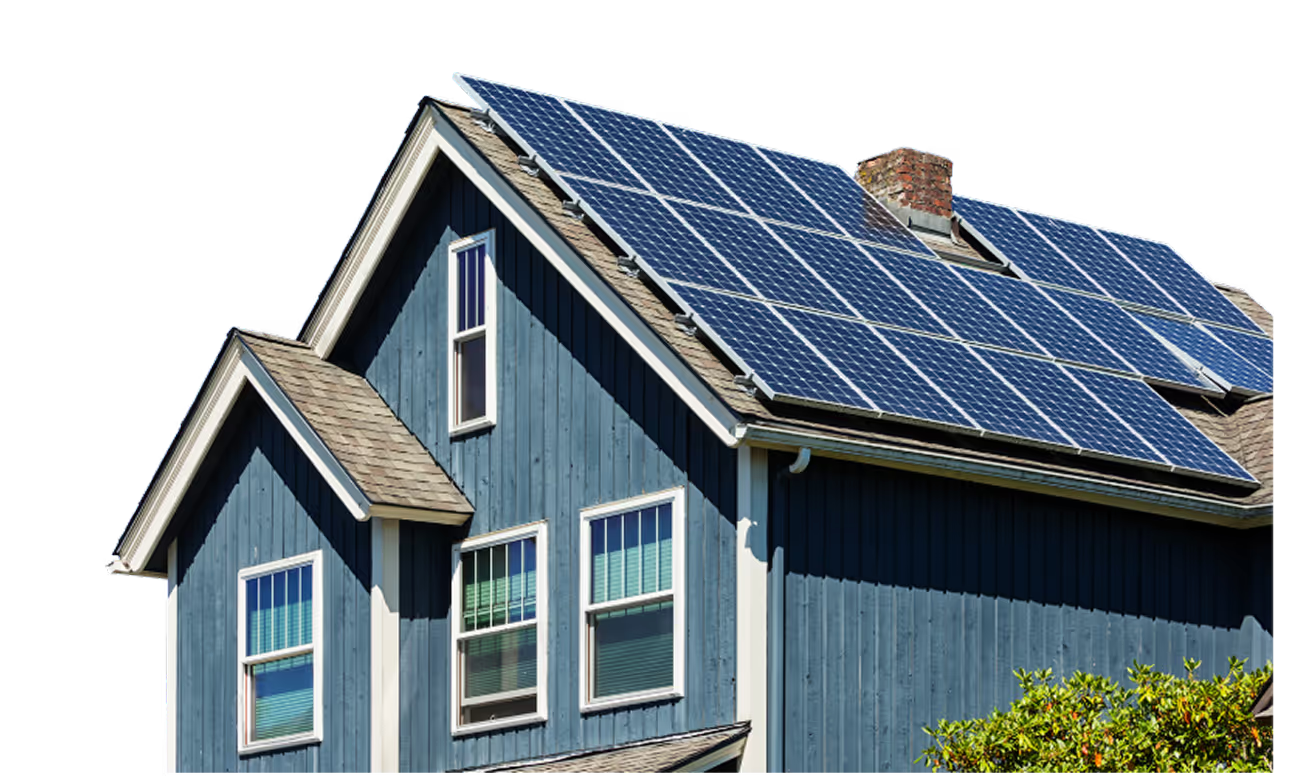
Key Takeaways:
AIKO's all-black ABC panels reach up to 24.8% efficiency and lose less power in Singapore's heat than TOPCon panels, with product warranties of up to 30 years depending on the model. On a roof that fits 16 panels, a 485 W AIKO system produces around 11% more electricity than 16 standard 440 W TOPCon panels. The premium pays off most on small or shaded roofs where you can't add more panels.
AIKO panels make more electricity from the same roof space, but that only matters if you can't simply fit more panels. That's the question behind every AIKO quote in Singapore.
If you've gotten solar quotes for your home, you've probably come across AIKO's all-black panels. They've become a popular premium choice, and installers tend to sell them with a wall of numbers: efficiency percentages, temperature coefficients, warranty years.
Those numbers matter here because landed roofs here have limited space, so every square metre has to work hard. A panel that produces more power from the same space, and loses less of it to heat, changes how much of your electricity bill solar can cover.
At 485 W, the AIKO Neostar 3S54 converts 24.3% of sunlight into electricity (the range tops out at 24.8%), while a typical 440 W TOPCon panel of the same size manages around 22%. TOPCon is the mainstream panel type most installers quote. AIKO panels also cost more, and the model, wattage and warranty on your quote all change what you actually get.
GetSolar installs the AIKO Neostar 3S54 on landed homes across Singapore, so this guide comes from working first-hand with the panel.
If you're new to solar altogether, start with our complete guide to solar energy in Singapore.
Who Makes AIKO Solar Panels?
AIKO Solar is a Chinese manufacturer founded in 2009 with roots in Zhuhai. It trades on the Shanghai Stock Exchange under SSE: 600732, and its range covers Neostar panels for homes, Comet for commercial roofs and Stellar for utility-scale plants.
AIKO’s product pages list it as a BloombergNEF Tier 1 manufacturer and a PVEL 2026 Top Performer, alongside a 5-star rating in PV Magazine's module test.
What Is AIKO's ABC Technology?
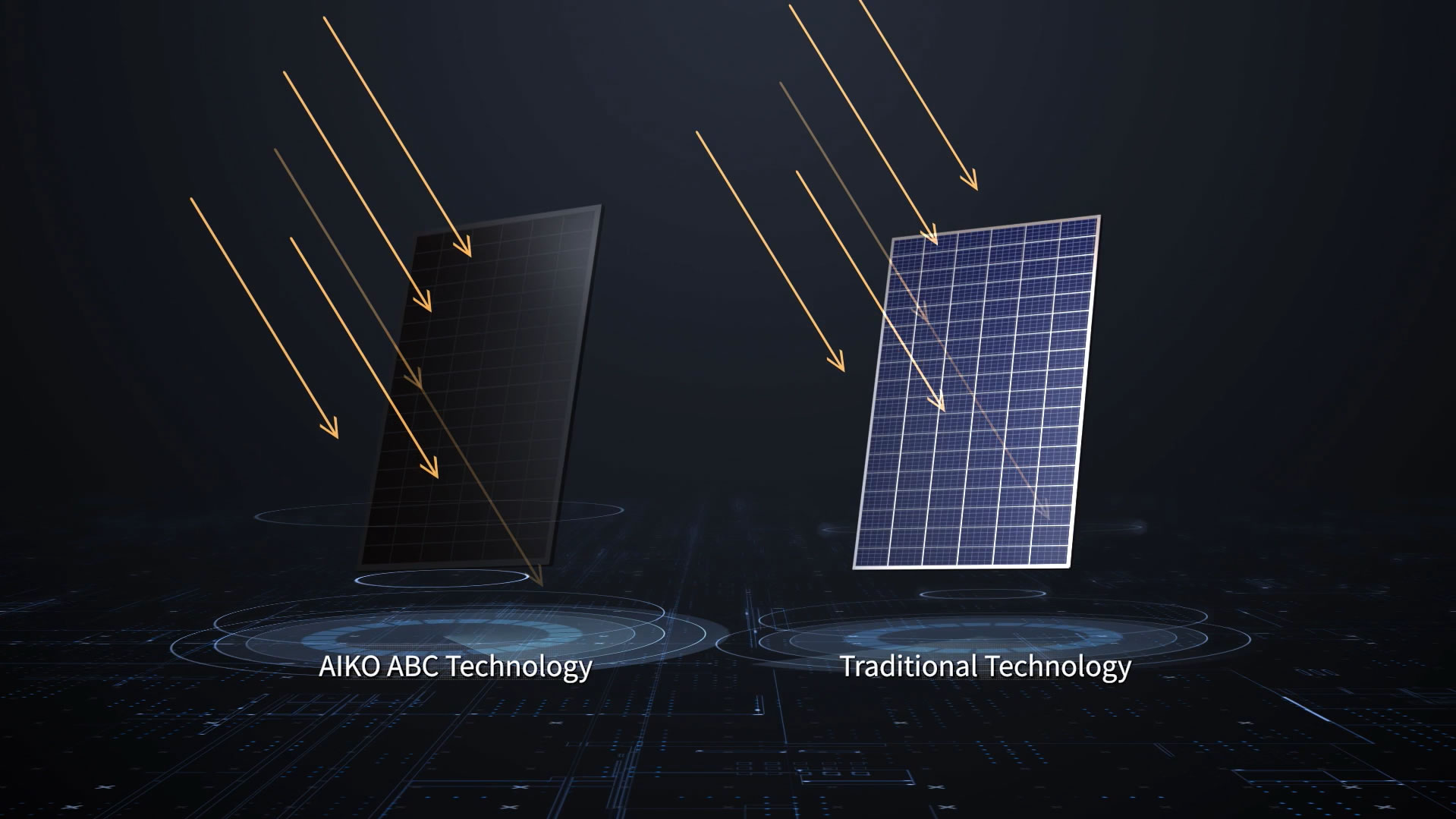
Most panels, including PERC and TOPCon, carry thin silver lines across the front of each cell to collect current. Those lines block a small share of incoming light.
AIKO's ABC (All Back Contact) design moves every contact to the back of the cell. With nothing on the front, more of the cell catches sunlight, and the panel looks like a single sheet of black glass.
For a refresher on the basics, see how solar panels work.
This design brings 3 practical benefits:
- More power per square metre: a 485 W Neostar 3S54 produces around 243 W/m², against around 220 W/m² for a 440 W TOPCon panel of the same size.
- Better heat tolerance: AIKO rates the Neostar range at −0.26%/°C
- Partial-shading optimisation: AIKO lists this as a Neostar feature, which helps on roofs that are shaded by water tanks, parapets or a neighbour's wall.
Why N-type cells matter
AIKO builds every Neostar cell on N-type silicon. Older P-type panels use boron, which reacts with oxygen once the panel meets sunlight and costs around 1–3% of output early on. N-type cells avoid that reaction, which is why AIKO can cap first-year loss at 1%.
The caveat is AIKO's mono-glass home panels use a solid backsheet, so they don't collect light from the rear. On a flush-mounted landed roof, that rarely costs you anything.
How Does AIKO's ABC Compare With TOPCon, HJT and PERC?
ABC leads on efficiency, HJT matches it on heat, and TOPCon remains the mainstream N-type panel most solar providers default to. EMA's handbook notes that cells in Singapore can pass 70°C in bright sun, so heat tolerance matters here more than in cooler markets.
Heat loss follows a simple formula: power lost (%) = (cell temperature − 25°C) × temperature coefficient. Given a 65°C cell, an AIKO panel loses 40 × 0.26% = 10.4% of its rated output.
Sources: AIKO Neostar datasheets and warranty terms; other rows are typical manufacturer datasheet and warranty ranges for residential panels.
ABC is the only one in the list with a clear front, which is why it leads in efficiency. HJT matches AIKO on heat but lags behind on efficiency, while PERC trails on every measure, including a first-year loss up to twice as large, and is fading from new quotes.
At a 65°C cell temperature, AIKO keeps 1.2 to 1.6 percentage points more output than a typical TOPCon panel. Cells only reach those temperatures in the hottest hours, so across a full year we estimate that works out to around 1% more energy.
ABC's real edge is efficiency; its heat advantage over modern TOPCon is real but small.
How Durable Are AIKO Panels?
The Neostar 3S54 datasheet rates the panel to a static load of 5,400 pascals (Pa) on the front and 2,400 Pa on the back, and tests it against 25 mm hail at 23 m/s. It uses 3.2 mm tempered glass, a black anodised aluminium frame and an IP68 (dust-tight and waterproof) junction box with 3 bypass diodes.
AIKO also lists salt mist, ammonia, sand and dust, and anti-PID testing for the 3S54. PID (potential-induced degradation) is a power loss that can build up in humid conditions. Salt mist resistance matters if you live near the coast, where sea air corrodes weaker frames and connectors.
Those tests point to a panel built to last. The warranty is what puts it in writing, and it depends on the exact model.
What Warranty Do AIKO Panels Come With?
AIKO's product warranty changes by model and wattage, which is why you see 15, 25 and 30 years quoted online. The Neostar 3S54 carries a 30-year product warranty in its 480–495 W versions and 25 years in its 460–475 W versions. The Neostar 2S+ carries 25 years, and the Neostar 2P starts at 15 years, which AIKO lists as extendable to 25.
The 30-year performance warranty is the same across all of them. Here's the minimum output it guarantees over time, against typical TOPCon terms:
Sources: AIKO Neostar warranty terms (≤1% year 1, ≤0.35%/year after); typical TOPCon terms of ≤1% year 1 and ≤0.4%/year after.
The guaranteed gap reaches only around 1.5 points by year 30. The product warranty is the bigger difference: 30 years on the right AIKO model, against the 12–15 years many TOPCon panels carry.
Two warranties sit on top of the panel warranty, and they matter just as much:
- Installer workmanship: covers wiring, mounting and roof penetrations. A great panel can't fix a poorly sealed bracket.
- System performance guarantee: covers what your whole system produces, not just one panel. GetSolar Singapore guarantees 90% of projected production, backed by a written payback commitment.
Check the exact wattage on your quote. On the Neostar 3S54, the step from 475 W to 480 W moves the product warranty from 25 to 30 years.
Are AIKO Panels Worth the Premium?
On a roof that fits 16 panels, a 485 W AIKO produces around 11% more electricity than 16 standard TOPCon panels. Most of that gap comes from the higher wattage per panel, with heat performance adding about one point. Against a 455 W TOPCon panel of the same size, the gap narrows to about 8%. Here's the comparison for a terrace-sized roof:
Assumptions: 1,250 kWh/kWp/year yield, 1% annual heat advantage for AIKO, before degradation. kWp (kilowatt-peak) is a system's rated capacity.
At SP Group's July to September 2026 household tariff of 34.78 cents/kWh including GST, that extra output is worth about S$347 a year, or roughly S$8,700 over 25 years. At a lower tariff of 30 cents, it's about S$300 a year, or S$7,500. Treat that as a rough ceiling on what the AIKO premium should cost on this roof. It assumes you use all of the extra solar yourself, a flat tariff and no discounting. Tariffs change every quarter, and our SP Group tariff guide tracks the latest rate.<br>
Here's the part most AIKO articles skip. TOPCon needs 18 panels (18 × 440 W = 7.92 kWp) to match 16 AIKO panels at 7.76 kWp, and at that size it produces slightly more, around 9,900 kWh a year. If your roof has space for those two extra panels, the AIKO output advantage disappears. The question then becomes whether two extra panels and their mounting cost less than the AIKO premium.
The gap also shrinks if nobody's home during the day, because solar you export earns less than solar you use. For full system pricing, see our solar installation and maintenance cost breakdown.
AIKO is worth it if
- Your roof is small or broken up: a terrace or cluster house where you can't fit 2 more panels gains the most from extra watts per panel.
- Parts of your roof get shade: partial-shading optimisation helps on roofs with water tanks, parapets or neighbouring walls.
- Looks matter to you: the all-black front has no visible grid lines, which suits a renovated façade.
TOPCon is the better buy if
- You have spare roof space: a semi-detached or bungalow roof can add panels for less than the AIKO premium.
- Nobody's home in the day: more of your solar gets exported at a lower rate, so the extra output is worth less.
Are AIKO Panels EMA or EMC Approved in Singapore?
Neither EMA nor EMC approves panel brands, but AIKO panels can go on any Singapore landed roof as long as the model carries the right IEC certification and a Licensed Electrical Worker (LEW) signs off the installation. EMA's Handbook for Solar PV Systems states that crystalline silicon modules should comply with IEC 61215, and Singapore has adopted the safety series as SS IEC 61730. SP Group then approves the grid connection.
EMC causes the most confusion. The Energy Market Company runs the wholesale electricity market and doesn't certify equipment, and SP Group notes that consumers under its simplified export arrangements don't need to register with EMC as a Market Participant. If someone means electromagnetic compatibility instead, that applies to your inverter, not the panels.
Sources: EMA Handbook for Solar PV Systems, Singapore Standards Council, SP Group.
You can also check that the panels on your roof are genuine. AIKO runs a module authenticity checker where you enter the serial number.
Approval for AIKO panels means IEC certification and LEW sign-off. Neither EMA nor EMC approves individual panel brands.
How Do You Check an AIKO Quote Before You Sign?
Whichever installer you pick, ask these 5 questions first:
- Which exact model and wattage is on the quote?
- Can you show me the IEC 61215 and IEC 61730 certificates for this model?
- Is the product warranty 15, 25 or 30 years for this exact wattage, and who registers any extension?
- Will you verify the serial numbers on AIKO's authenticity checker after delivery?
- Who handles warranty claims in Singapore, and do you guarantee the system's production?
GetSolar Singapore installs the all-black AIKO Neostar 3S54, and we're happy to walk you through how it compares on your roof. For how ABC compares with other panel types, see our guide to types of solar panels.
For a deeper look at sizing, costs and savings for a landed home, see our complete guide to solar energy in Singapore.
The best panel is the one that fills your roof at the lowest cost per kWh, backed by an installer who guarantees the output.
Frequently Asked Questions
Are AIKO solar panels good?
Yes. AIKO is a BloombergNEF Tier 1 manufacturer, and its Neostar panels reach up to 24.8% efficiency with a −0.26%/°C temperature coefficient, one of the better heat ratings for Singapore roofs. Whether they're good value depends on your roof space and the price gap against TOPCon.
Who makes AIKO panels and where are they from?
AIKO Solar, a Chinese manufacturer founded in 2009 with roots in Zhuhai. It trades on the Shanghai Stock Exchange under the code 600732.
Are AIKO solar panels EMA or EMC approved in Singapore?
Neither body approves panel brands. EMA's solar handbook points to IEC 61215 for panels, and the Energy Market Company runs the wholesale electricity market without certifying equipment. What matters is IEC 61215 and IEC 61730 certification, an LEW signing off your installation, and SP Group approving the grid connection.
Which AIKO panel does GetSolar use?
GetSolar Singapore installs the all-black AIKO Neostar 3S54 in its 485 W version, with 24.3% efficiency, a 30-year product warranty and a 30-year performance warranty. Every system also carries GetSolar's 90% production guarantee.
What warranty do AIKO panels come with?
All Neostar models carry a 30-year performance warranty, guaranteeing around 88.85% of rated output at year 30. The product warranty is 30 years on the Neostar 3S54 in its 480–495 W versions, 25 years on its 460–475 W versions and on the Neostar 2S+, and 15 years, extendable to 25, on the Neostar 2P.
How long do AIKO solar panels last?
AIKO warrants Neostar panels to keep around 88.85% of their rated output after 30 years, with degradation capped at 0.35%/year after year 1. Most homeowners can plan on 30 years of production.
Are AIKO panels better than Trina or other TOPCon panels?
AIKO produces more per panel and loses less output in heat, around 11% more electricity on a 16-panel roof. If you can fit 2 extra TOPCon panels instead, most of that gap closes, so the better choice depends on your roof space and the price difference.
Great Panels Still Need the Right Roof
AIKO's ABC panels deliver more power per square metre, strong heat tolerance and up to 30 years of product warranty on the right model. On a 16-panel roof, that's around 11% more electricity than standard TOPCon from the same space.
Whether that's worth paying for comes down to your roof. Compare the extra output against the real price gap between quotes, and check the exact model and wattage before you sign.
Check out our free solar calculator to calculate your potential roof savings, or chat with our solar advisors for a no-obligation assessment.

Rent-to-Own Solar for Business with Guaranteed Performance
Immediate ROI


Rent-to-Own Solar. $0 Upfront cost. Guaranteed Savings
(10-Year RTO plan)
+ 10-Year Free Maintenance

Be part of The Solar Collective, where we share the latest updates, tips, and discussions on solar energy.