[Updated, September 2026]
Solar and Electric Vehicles (EVs) make a natural pairing, and with Singapore's electricity tariff at its highest recorded level, the case for putting the two together is stronger than it has been.
Whether you're a seasoned EV owner or considering making the switch, understanding the impact and advantages of solar EV charging stations will aid you in making informed decisions that benefit both the planet and your wallet.
Can EVs Be Charged At Home?
Absolutely! Installing an EV charger in the comfort of your home provides unmatched convenience to your daily routine. If you’re on the hunt for reliable EV charger installers, we’ve curated a comprehensive all-you-need guide for EV home charging!
How Much Are EV Home Chargers?
Installing an EV home charger is an investment that ranges depending on your specific charging needs. For example, mid-range EV home chargers typically cost between S$1,000 to S$2,500, while models with higher charging capacities can go up to about S$4,000.
Keep in mind, there will likely be additional costs such as cabling that can vary based on the distance between your power source and the EV charger.
Before making the purchase, it would be smart to consult a list of professional EV charger installers to ensure that your charging station fits perfectly with your home setup and charging needs.
Can EVs Be Charged By Solar?
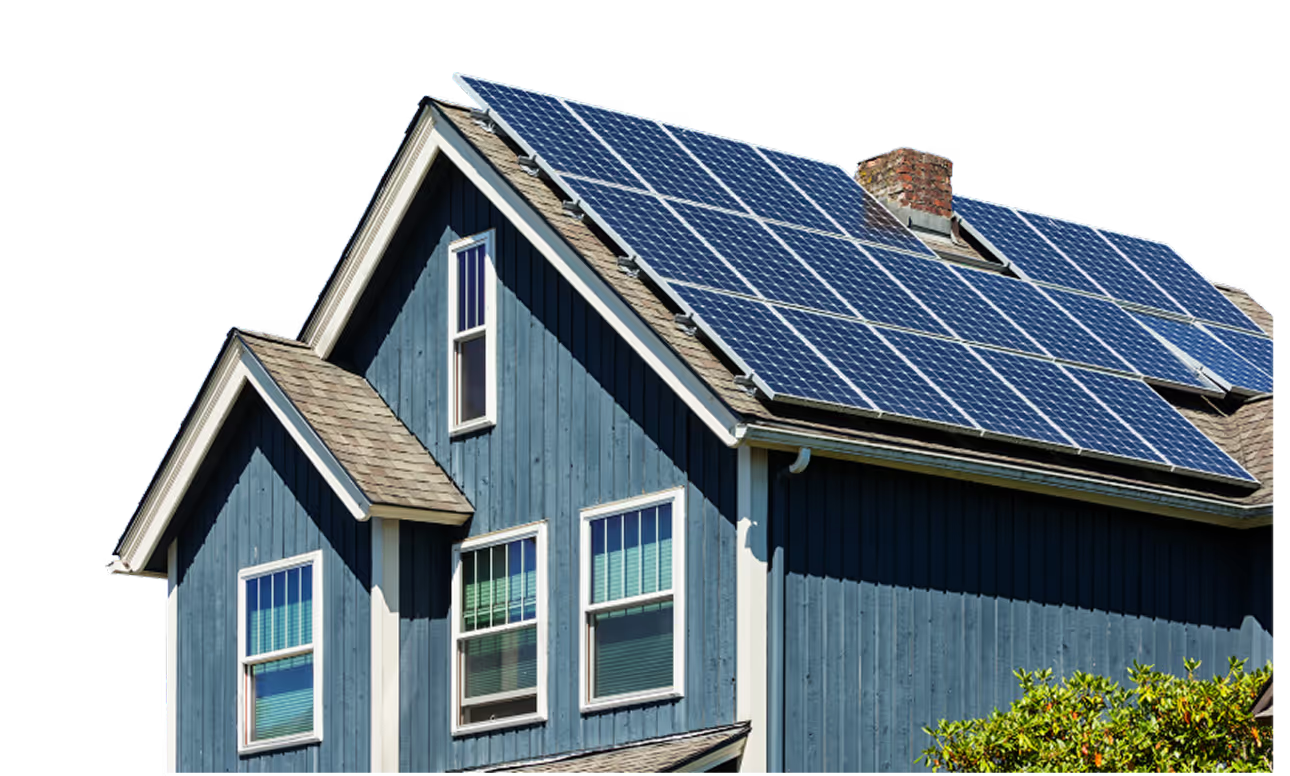
Yes! By having solar panels at home, you can harness the sun's energy to generate electricity, which can then be used to power your EV. Not only that, but your vehicle can also be powered by clean and green energy, instead of electricity generated from traditional, "dirty" fossil fuels.
We understand that the initial high cost can be daunting. At GetSolar, we're committed to making solar energy both accessible and affordable for everyone, which is why we've developed a unique model, where you pay $0 upfront for your solar panels.
Curious to know how much you could save by installing solar panels? Check out our free solar calculator for an estimate in under a minute.
How Does Solar Charge EVs?
Here's a brief rundown of how solar panels convert sunlight into renewable energy that charges your EV. Don't worry, we'll skip most of the technical jargon.
- It all starts with the Photovoltaic (PV) cells found in solar panels. These cells convert sunlight into direct current electricity.
- The direct current (DC) electricity generated by the solar panels is fed into a solar inverter.
- Afterward, direct current (DC) electricity is converted into alternating current (AC) electricity. This is the type of electricity that your EV and general household appliances use.
- The AC electricity is then routed to your home's electrical distribution box or DB box for short.
- From here, any household appliance, including an EV charger, can be fed electricity.
If you're interested in knowing how solar panels work, we've got you covered with an in-depth informative article.
The Financial And Environmental Benefits From Solar EV Charging
Singapore's household electricity tariff reached 34.78 cents per kWh (including GST) for Q3 2026, a 17% rise in a single quarter and the highest rate on record. Every kilowatt-hour your EV draws from the grid costs more than it did in April, which makes generating your own more appealing. You can see how the regulated tariff compares against retailer plans in our electricity price comparison.
If you're considering an electric vehicle, pairing it with a solar system is a smart move. Here's why:
Even More Savings!
Charging your EV with solar power makes perfect sense. This ideal pairing not only supports a greener planet but also buffers against the fluctuating costs of fossil fuels associated with petrol vehicles.
Charging with Solar Energy vs Traditional Gasoline ($/kWh)
You may be wondering what the price difference is between charging with solar energy and traditional gasoline.
Assuming you installed an EV charging station at home, your cost to charge your vehicle would be close to zero as electricity is generated from the sun. What about public charging stations? Our guide to EV charging stations in Singapore shows public AC charging sits at a median of around S$0.69/kWh, with DC fast charging closer to S$0.80/kWh.
Suppose you drive 100 km, and an EV consumes 0.2 kWh/km on average. To put things into perspective, let's do a brief overview:
Sources: SP Group electricity tariff, 1 July to 30 September 2026; listed RON 95 pump prices, September 2026; median public AC charging rates across Singapore operators, 2026.
Without much calculation, it’s clear that EVs are significantly cheaper compared to traditional gasoline vehicles. Even more so, solar-powered home chargers are the obvious choice, making them an extremely cost-effective and environmentally friendly option for powering electric vehicles in Singapore
So, why pay for fuel when the sun is free?
Increased Home Value
For the house flippers, this one's especially for you! It's straightforward: homes equipped with solar energy systems are more attractive to buyers, enhancing property value. And not forgetting your EV charging stations, the value of your property increases even more.
Don't just take it from us! Join our active community on Telegram, where like-minded solar EV owners discuss and share their own tips and advice!
How Many Solar Panels Will I Need To Charge An EV?
The number of solar panels you need to charge an EV largely depends on the type of solar panels you use. Typically, you'll need an average of 4-5 solar panels to offset traditional fuel costs for your daily commute. However, imagine the additional savings and benefits you could achieve just by increasing your solar capacity.
By adding more panels, you could power everything from your air conditioner to your refrigerator, further reducing your electricity bills. You're not only maximising your investment in solar energy but also enhancing your energy independence.
With that in mind, here's an easy-to-understand calculation of the number of solar panels needed to charge an EV.
Step 1: Determining Your EV's Energy Efficiency
Find out how many kilowatt-hours (kWh) your EV consumes per kilometre (km).
Example:
Typical EV Consumption: 0.2 kWh/km
Step 2: Calculate Your Daily Energy Usage
Multiply the kWh per km figure by your average daily kilometres travelled.
For a typical Singaporean commute, let's assume about 40 kilometres for a round-trip.
Example:
Daily Energy Usage: 0.2 kWh/km × 40 km = 8 kWh/day
Step 3: Account for Local Sunlight
Singapore experiences about 4 peak sun hours per day on average.
Divide your daily kWh requirement by these peak sun hours to estimate the required solar system size in kilowatt peak (kWp).
Example:
Required Solar System Size (kWp): 8 kWh/day / 4 hours = 2 kWp
Step 4: Calculating the Number of Solar Panels Needed
Note that the performance of solar panels varies depending on their efficiency and size. For ease of understanding and calculation, we'll use a panel with a 500Wp rating, which typically represents the average maximum output under ideal conditions.
Divide your daily kWh usage by the solar panel's kilowatt rating to calculate the number of panels needed.
Example:
No. of Panels Required: 2 kWp / 0.5 kW = 4 panels
For a typical daily commute in Singapore, you would require an estimate of 4 solar panels of 500 Watts each to completely cover your EV's daily energy consumption.
Solar EV Charging: Better For EVs?
Solar and EVs work better together than either does alone. Your panels cover the daily commute, your roof covers the rest of the house, and the grid handles whatever's left.
Check out our free solar calculator to calculate your potential roof savings, or chat with our solar advisors for a no-obligation assessment.

Rent-to-Own Solar for Business with Guaranteed Performance
Immediate ROI



Rent-to-Own Solar. $0 Upfront cost. Guaranteed Savings
(10-Year RTO plan)
+ 10-Year Free Maintenance

Be part of The Solar Collective, where we share the latest updates, tips, and discussions on solar energy.



.png)