Key Takeaways:
Home charging is the cheapest and most convenient way to keep your EV topped up in Malaysia, typically costing RM15–RM25 per full charge at TNB rates. Public charging is useful for long trips but costs significantly more per kWh. Pairing a home charger with a rooftop solar system under Solar ATAP reduces effective charging costs to near-zero, turning your EV into one of the strongest financial arguments for going solar.
Your EV dealer told you about the savings. They didn't tell you about the TNB bill.
For most Malaysian EV owners, home charging is where the numbers either work or quietly don't. Malaysia has three charging environments: home, public, and workplace. Each has a different cost per kWh, different speeds, and different tradeoffs.
This guide breaks down what each option actually costs, what your home's electrical supply needs to handle a charger, and why adding solar to the equation turns your EV's running cost to near-zero.

The Three Types of EV Charging in Malaysia
EV chargers in Malaysia split into two technologies (AC & DC) which map onto three real-world settings.
AC charging uses your home or workplace's alternating current supply and converts it inside the car. It's slower but works with standard electrical infrastructure. Most home chargers and workplace chargers are AC.
DC fast charging skips the car's onboard converter and pushes direct current straight into the battery. It's fast but requires dedicated infrastructure and costs more per kWh.
For day-to-day use, AC Level 2 at home hits the sweet spot since it’s fast enough to fully charge overnight, and cheap enough to run every night.
How Much Does It Cost to Charge an EV at Home in Malaysia?
Home charging runs on TNB's domestic tariff, which increases in tiers as your monthly usage climbs. Add an EV to your household and you will almost always push into a higher tier.
TNB's domestic tariff (effective July 2025):
Formula: battery capacity (kWh) × tariff rate (RM/kWh) = cost per full charge
What that looks like for common EVs in Malaysia:
For a typical driver covering 1,500 km/month, EV consumption runs around 225–300 kWh/month (assuming 15–20 kWh/100 km). That adds roughly RM75–RM170 to your monthly bill depending on which tariff block you sit in.
For a detailed walkthrough of how these numbers look on your actual TNB bill, see our guide on how much it costs to charge an EV at home in Malaysia.
Public EV Charging in Malaysia Is Convenient but Costly
Public charging infrastructure in Malaysia has grown fast in recent years. ChargEV, JomCharge, and TNB's own network now cover major highways, malls, and urban carparks across Peninsular Malaysia.
However, public charging costs 2–4 times more per kWh than home charging.
Rates indicative as of Q2 2026. Check operator apps for current pricing.
A 50 kWh top-up at a DC fast charger costs RM45–RM60. The same charge at home costs RM17–RM25. Public charging makes more sense for long road trips or emergency top-ups, but definitely not as your primary daily option.
Workplace Charging: A Useful Bonus, Not a Strategy
A growing number of Malaysian employers are installing EV chargers within their premises as staff perks and when it's available, it's worth using. Some offer free charging; others charge a subsidised rate well below public network prices.
Workplace charging is worth using when available. But it's not a substitute for home charging as your primary source because:
- Availability is unreliable. Shared chargers can fill up fast during office hours.
- You can't charge overnight
- Free charging perks can be adjusted or removed at any time.
Use it as a supplement to home charging, not a substitute.
Can Your Home's Electrical Supply Handle an EV Charger?
Before buying a wallbox, check your home's incoming supply capacity. A 7 kW AC charger draws around 32A. Add air conditioning, water heaters, and standard household loads, and the total demand climbs fast.
Here's what your supply rating means in practice:
- 60A supply: Feasible, but headroom is tight alongside AC, water heaters, and other loads.
- 100A supply: Comfortable capacity for a 7 kW charger plus normal household loads.
- Three-phase supply: Rare in older houses, but enables 22 kW charging. Useful if you have multiple EVs or a larger battery.
A Licensed Electrical Worker (LEW) assessment is mandatory before conducting any charger installation in Malaysia. Budget RM150–RM300 for the assessment alone. Home wallbox installation typically costs RM1,500–RM4,000 depending on cable run distance and any panel upgrades required.
Why Solar Panels Cut EV Charging Costs to Near-Zero
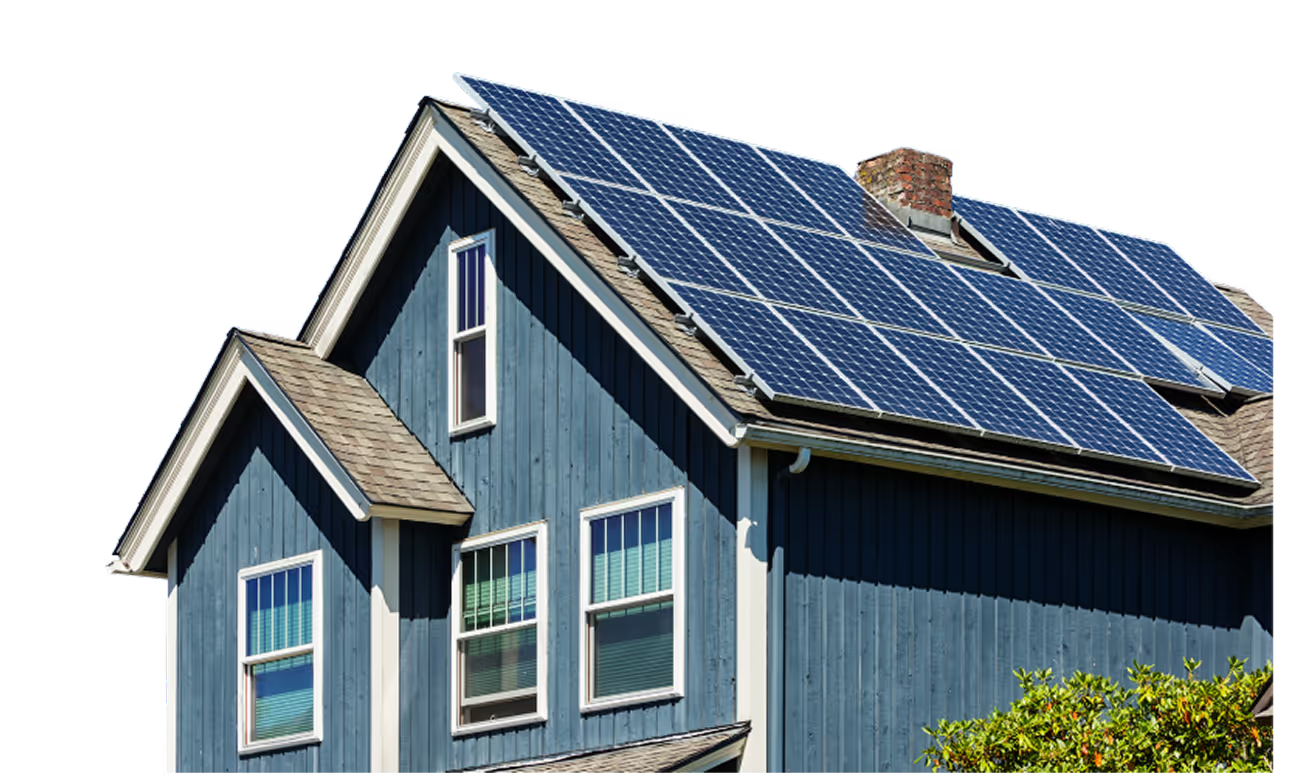
A rooftop solar system generates electricity during daylight hours, typically 7am to 6pm. During those hours, solar offsets your home's daytime loads: air conditioning, water heaters, appliances. Every kWh your roof generates is a kWh you don't import from TNB at full retail rate.
With an EV in the picture:
- Solar offsets your household's daytime consumption, shrinking the net kWh you draw from the grid each month.
- When you charge at home at night, you're drawing from TNB. But your monthly import total is already significantly lower because solar covered the day.
- With a hybrid solar system and battery storage, you can charge the car directly from stored solar energy overnight.
Under Malaysia's Solar ATAP programme which replaced the earlier Net Energy Metering (NEM) scheme, surplus solar energy exports earn credits at RM0.27–RM0.37/kWh. Those credits offset your import bill further, including the additional load from your EV. Solar also protects you from AFA surcharges, the monthly fuel-cost adjustment that can push your TNB bill up without warning, regardless of how much energy you use.
A worked example: an 8 kWp system on a landed home in Selangor generates around 900–1,000 kWh/month. A household with a Proton e.MAS consuming 700 kWh total (including EV charging) effectively reduces its net grid import to near-zero after self-consumption and export credits are applied.
For homes with a monthly TNB bill above RM400, an EV is one of the strongest financial arguments for going solar because the incremental EV load makes a well-sized solar system pay back faster.
For a fuller picture of how this works, see our breakdown of EV tax rebates and solar savings in Malaysia.
How to Install an EV Charger at Home with Solar in Mind
If you're starting fresh or planning to add solar alongside your charger, this is the logical sequence:
- Check your supply capacity. Engage a LEW to assess your incoming supply rating and whether a panel upgrade is needed.
- Size your solar system for EV load. Tell your solar provider your EV's battery capacity and monthly driving distance. This changes the optimal system size.
- Choose your charger. For single-phase homes, a 7 kW AC wallbox is the standard recommendation. For three-phase homes, a 22 kW unit is possible but rarely necessary for residential use.
- Apply for Solar ATAP. Your solar provider handles the eATAP submission and TNB meter installation. You don't need to manage this yourself.
- Install both in a single visit where possible. Combining solar and charger installation reduces scaffolding costs and electrical panel work to a single mobilisation.
With GetSolar's Rent-to-Own plan at RM0 upfront, you can have solar generating from your roof without tying up capital. Read more about how RTO solar financing works and what the monthly commitment looks like.
Your Car Is Free to Run. You Just Need the Right Setup at Home.
Home charging beats public and workplace charging on cost anytime. At TNB's domestic tariff rate, you're essentially paying RM15–RM25 per full charge. At a DC fast charger on a public network, that number doubles.
With solar, the effective cost drops further. Your roof generates electricity during the day, shrinking the net grid import your EV charging adds each month. For a landed homeowner with a monthly bill above RM400 and an EV in the garage, the payback on solar shortens considerably.
Check out our solar calculator for a FREE analysis of your rooftop or chat with the team on WhatsApp whenever you're ready.

Rent-to-Own Solar. RM0 Upfront cost. Guaranteed Savings
Immediate ROI



Rent-to-Own Solar. RM0 Upfront cost. Guaranteed Savings
(10-Year RTO plan)
+ 10-Year Free Maintenance

Be part of The Solar Collective, where we share the latest updates, tips, and discussions on solar energy.

%20Price%20per%20Sq%20Ft.webp)
%20vs%20Assessment%20Tax%20(Cukai%20Pintu)%20Key%20Differences.webp)