Key Takeaways:
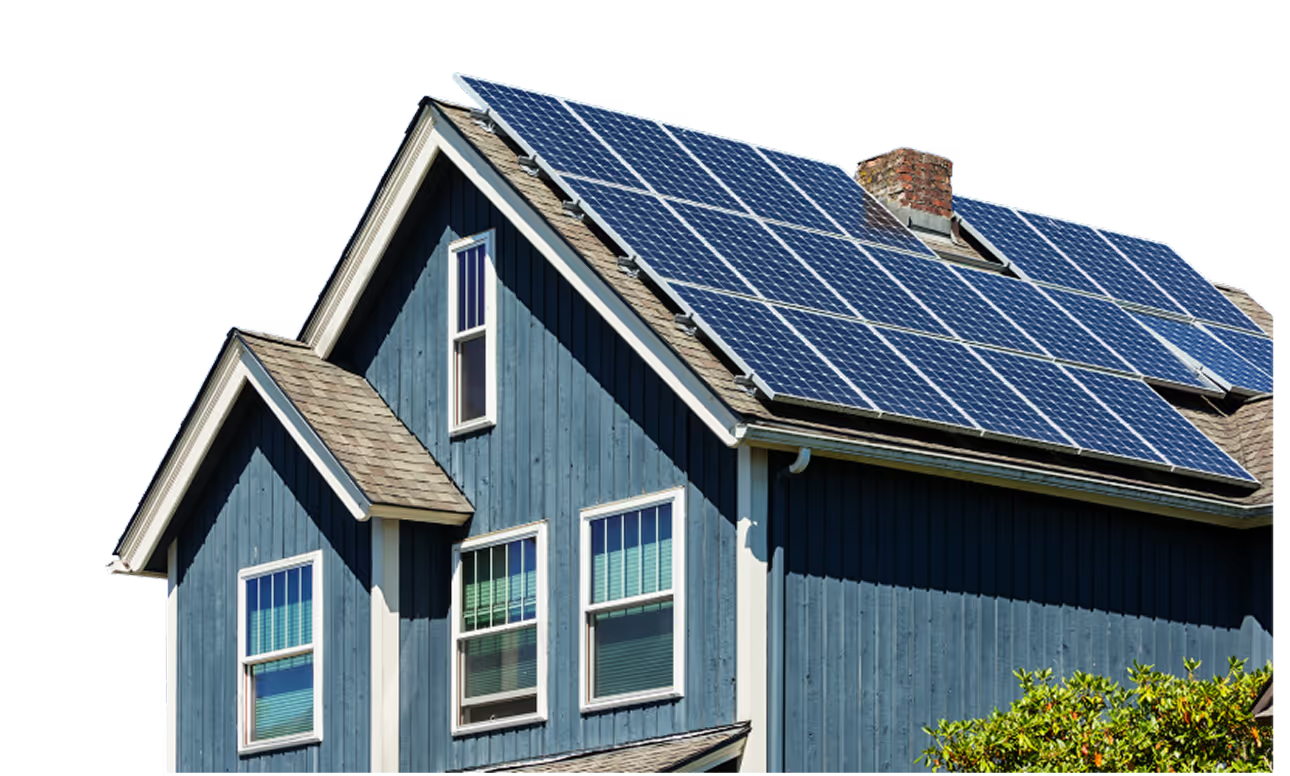
Malaysia targets 70% renewable energy capacity by 2050 under the NETR. The transition is already showing up on your TNB bill through AFA volatility, Solar ATAP export rates, and the new tariff structure under RP4. Solar is the most direct way for landed homeowners to benefit from the shift instead of absorbing its costs.
In October 2025, the government committed Malaysia to 70% renewable energy capacity by 2050 under Budget 2026. Six months later, in April 2026, TNB cut the AFA rebate by 78%, adding around RM14 to a typical 800 kWh household bill overnight.
Three things have changed in the last 12 months. NEM ended in June 2025. AFA replaced ICPT on 1 July 2025. Solar ATAP launched on 1 January 2026. If you haven't kept up with these shifts, you're paying a tax for not knowing.
This guide explains Malaysia's renewable energy framework in plain language: what's been funded, what's already in motion, and what each piece means for your TNB bill.
Where Malaysia Is Heading: The 2050 Renewable Energy Target
Malaysia's renewable energy journey is detailed inside the National Energy Transition Roadmap (NETR), launched in July 2023. It sets three time-based milestones: 31% renewable energy installed capacity by 2025, 40% by 2035, and 70% by 2050.
The 2025 target has already been hit. Malaysia closed out 2025 at 31% installed RE capacity, with solar making up around 92% of all national renewable capacity. Cumulative solar PV capacity, across utility-scale, NEM, and Feed-in Tariff projects, is now in the region of 5,700 MW.
The long-term plan leans heavily on solar. By 2050, the NETR projects solar will account for roughly 58% of installed capacity, hydro at 11%, and the remainder split between bioenergy and natural gas as a transition fuel. Rooftop solar is the segment expected to do the heavy lifting for the next milestones.
The Three Policy Shifts That Already Affect Your Bill
Each of these took effect in the last 12 months. Each one changed how you pay for electricity.
NEM 3.0 ended in June 2025. It was replaced by Solar ATAP (Solar Accelerated Transition Action Programme) from 1 January 2026. ATAP has no national quota, allows residential systems up to 5 kWac (single-phase) or 15 kWac (three-phase), and credits residential exports at retail-linked rates instead of NEM's near 1-to-1 offset.
ICPT was replaced by AFA on 1 July 2025. The Automatic Fuel Adjustment (AFA) recalculates monthly, capped at ±3 sen/kWh, with the first 600 kWh of domestic usage exempt. Bills now move with global fuel prices and the MYR/USD rate every single month, not twice a year.
A new TNB tariff structure took effect on 1 July 2025 under Regulatory Period 4 (RP4). The base tariff rose 13.6% to 45.4 sen/kWh, the first increase in over a decade. Bills are now broken down into separate Energy, Capacity, Network, and Retail charges, plus an optional Time-of-Use (ToU) tariff that rewards shifting heavy usage to off-peak hours.
Budget 2026: What's Funded and What's Coming
Budget 2026 put real money behind the NETR targets. The headline allocations:
Sources: Budget 2026 speech (October 2025), MIDA, SEDA Malaysia.
The carbon tax matters even for homeowners who'll never pay it directly. It hardens the cost trajectory for fossil-based electricity, which means tariff pressure won't ease.
Where Rooftop Solar Fits In: The NEM vs Solar ATAP Comparison
For landed homeowners, the most relevant policy in this list is Solar ATAP. Here's how it differs from the scheme it replaced:
Sources: SEDA Malaysia, Energy Commission Solar ATAP Guidelines (December 2025).
ATAP rewards systems sized to actual usage, not maximum export. For higher-consumption homes (above 1,500 kWh/month), the RM0.37/kWh export rate is better than many initially expected. For a deeper breakdown of how ATAP works and who qualifies, see our Solar ATAP NEM replacement guide.
Note: Solar ATAP does not apply to Sarawak. Sarawak runs its own NEM scheme under Sarawak Energy, which now offers a direct cash subsidy of up to RM12,000 for residential rooftop solar.
What This All Means for Your TNB Bill
Bills will keep moving every month. AFA recalculates monthly. TNB's own forecasts show rebates trending toward zero through mid-2026. You can't budget around a number that is constantly changing.
Tariff hikes are the structural trend. RP4 unbundled charges, the carbon tax, and rising global fuel costs all push in the same direction. Geopolitical events compound this pressure with the Iran conflict alone pushing Brent crude from USD 70 to nearly USD 120 per barrel, and Malaysia importing roughly 69% of its crude oil.
Solar is the only line item you actually control. Every kilowatt-hour your roof generates is a kilowatt-hour you don't import at TNB's full retail rate. For a 5- to 8 kWp system on a typical landed home, that translates to RM200- to RM400 less in monthly grid imports.
If you're starting from scratch, our Solar Panel Cost Malaysia 2026 guide breaks down what real installations cost today, and our Solar Panel Price List shows brand-by-brand pricing.
Should You Wait for More Incentives?
Honest answer: No.
Peninsular Malaysia doesn't currently have a direct cash subsidy for residential solar like Sarawak's. The headline financing incentive is GTFS 5.0, which subsidises business loans rather than putting cash in homeowner pockets. For homeowners, the practical path remains a hybrid solar system under Solar ATAP, paid outright or through a Rent-to-Own arrangement.
Meanwhile, solar module prices have started rising. Prices already moved up 10–15% between December 2025 and January 2026 as manufacturers pre-adjusted ahead of China removing its 9% VAT export rebate on photovoltaic products in April 2026. Modules are projected to climb further from around USD 0.12/W to roughly USD 0.13/W by mid-2026.
Tariffs are rising. Module prices are rising. The math doesn't reward waiting.
The Transition Is Already Here. Who’s Paying For It?
Malaysia's renewable energy targets are real, funded, and already affecting your bill. AFA reset the rules on monthly volatility. Solar ATAP reset the rules on rooftop solar. RP4 reset the rules on tariff structure.
Homeowners who go solar early shift from absorbing the cost of the transition to benefiting from it. The longer you stay fully grid-dependent, the more of the country's energy transition you fund through your monthly bill. The good news is that acting doesn't require a large upfront commitment as Rent-to-Own means you can start with RM0 down payment.
Ready to explore guaranteed solar savings for your home? Get your free personalised quote today. Or chat with us on WhatsApp for friendly, honest advice.

Rent-to-Own Solar. RM0 Upfront cost. Guaranteed Savings
Immediate ROI


Rent-to-Own Solar. RM0 Upfront cost. Guaranteed Savings
(10-Year RTO plan)
+ 10-Year Free Maintenance

Be part of The Solar Collective, where we share the latest updates, tips, and discussions on solar energy.