Key Takeaways:
Monsoon storms rarely damage a properly installed solar panel. Certified panels are tested to withstand 2,400 Pa of wind load and 25 mm hail at 23 m/s, well beyond what Malaysian storms usually deliver. The real monsoon risks are lightning surges, weak mounting and inverters placed where floodwater can reach them.
Every year from late October to March, the Northeast Monsoon pushes heavy rain and strong winds across Malaysia. If you have panels on your roof, the first big storm raises an obvious question: can monsoon storms damage solar panels?
The short answer is rarely, if they were installed properly. Panels are tested for far harsher weather than a Malaysian monsoon. The damage that does happen tends to come from three quieter sources: lightning surges, loose mounting and equipment placed where floodwater can reach it.
Below, we break down each monsoon hazard, how much risk it poses to your system and the simple checks that keep your savings running through the wet season.
Can Monsoon Rain Damage Solar Panels?
Monsoon rain cannot damage a certified solar panel, because panels are sealed units built to survive decades of heat and humidity. To pass IEC 61215, the global design standard for crystalline panels, a module spends 1,000 hours in a test chamber at 85°C and 85% humidity, far harsher than a wet week in Kuantan.
Rain even does your panels a small favour by rinsing off loose dust. What it does affect is output: heavy cloud cuts generation for the day, which we explain in do solar panels work on rainy or cloudy days. Lower output on a grey day is normal and not a sign of damage.
How Strong Are Solar Panels Against Monsoon Winds?
Certified panels are typically rated for 2,400 Pa of wind load on the front and back, several times what Malaysian storms deliver. MetMalaysia's 2025 climate summary recorded the country's highest maximum wind speed at 23.3 m/s in Kudat, Sabah.
By our own calculation, a 23.3 m/s wind exerts about 330 Pa of pressure, roughly one-seventh of that 2,400 Pa rating. Roof edges and corners see stronger uplift than the middle of the roof, so in a storm the weak point is the mounting, not the glass. Rails, clamps and roof fixings must suit your roof type, which is why a proper roof suitability check matters before installation.
Which Monsoon Risks Actually Matter for Solar Panels?
Lightning and flooding pose more risk to a solar system than rain, wind or hail. Here's how each hazard compares:
| Monsoon hazard | What panels are tested for | Risk to your system | What protects you |
|---|---|---|---|
| Heavy rain | 1,000 h at 85°C, 85% humidity | Low | Sealed panels, well-sealed roof fixings |
| Strong wind | 2,400 Pa front and back | Low | Correct rail spacing and clamping |
| Hail | 25 mm ice ball at 23 m/s | Low | Tempered glass |
| Lightning | Not part of panel testing | Moderate to high | Surge protection and proper earthing |
| Flooding | Panels sit on the roof | Low for panels, high for ground-level equipment | Inverter and battery mounted above flood level |
| Falling branches | Not part of panel testing | Depends on nearby trees | Trimming before the season |
Test levels: IEC 61215, as listed on manufacturer datasheets. Risk ratings are GetSolar's assessment for Malaysian landed homes.
The pattern is clear: the panel is the toughest part of the system. Your protection effort should go to the electrics and the equipment closest to the ground.
Is Lightning the Biggest Monsoon Risk for Solar Panels?
Lightning is the monsoon hazard most likely to damage a solar system in Malaysia, usually through a power surge rather than a direct strike. The same MetMalaysia summary shows Subang recorded 294 lightning days in 2025, the most of any of its 42 principal weather stations.
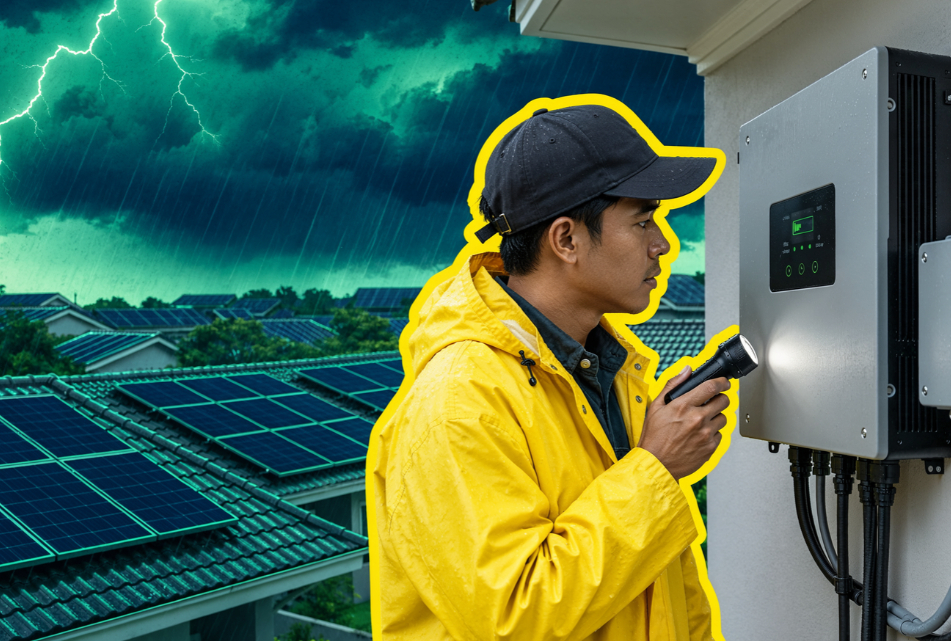
A nearby strike can push a surge through the DC cables into your inverter, the most expensive single component to replace. Surge protection devices (SPDs) on both the DC and AC side, plus proper earthing, divert that energy safely. Our surge protection guide explains how they work, and our piece on lightning arresters for homes covers whether you need one. If a quote doesn't list SPDs, ask why: it's one of the questions to ask before signing a solar quote.
What Happens to Solar Panels During a Flood?
Roof-mounted panels sit well above floodwater, so in a flood the parts at risk are the inverter, any battery and the wiring at ground level. For the 2026/2027 season, MetMalaysia expects three to five episodes of continuous heavy rain between November and January, with flood risk highest in low-lying areas and near rivers.
If your home has flooded before, mount the inverter and any battery above the known flood line. If water does reach them, leave the system off and have a Licensed Electrical Worker (LEW) inspect it before you switch it back on.
Can Storms Cause Roof Leaks Around Solar Panels?
Solar panels don't let water in; leaks only happen where roof fixings were drilled and sealed poorly. Monsoon downpours expose bad sealing quickly, so a leak during the first heavy storm after installation usually points to workmanship. We explain what to look for in do solar panels cause roof leaks.
How Should You Prepare Your Solar System for Monsoon Season?
A 15-minute check before the rains start covers most of the risk. Run through these:
- Record your baseline output: note a typical sunny-day reading in your solar monitoring app so a sudden drop after a storm stands out.
- Trim overhanging branches: falling limbs are a bigger threat to panel glass than wind itself.
- Confirm surge protection: ask your installer whether SPDs are fitted on both the DC and AC side.
- Check what covers storm damage: a solar panel warranty covers manufacturing defects, not lightning or falling trees, which fall to insurance.
- Inspect from the ground after a storm: look for cracked glass, shifted panels or loose cables, and leave roof access to your installer.
Monsoon and Solar Panels: Quick Answers
Should I switch off my solar system during a thunderstorm?
No. A grid-tied inverter shuts itself down automatically when the grid goes down, and switching off manually won't stop a lightning surge. Surge protection does that job.
Do solar panels attract lightning?
No. Panels add little height to a roof, so they don't make a strike meaningfully more likely. They do add cabling a nearby surge can travel through, which is why surge protection matters.
Does monsoon rain clean solar panels?
Partly. Rain rinses off loose dust but not bird droppings or sticky grime, so an occasional wash is still worth it. Our solar panel maintenance cost guide shows what that costs.
For a deeper look at who pays for repairs over a system's life, see what GetSolar's Rent-to-Own warranty covers.
Your Panels Can Handle the Monsoon. Make Sure the Installation Can Too
Certified panels are built for far worse than a Malaysian storm: the strongest wind MetMalaysia recorded in 2025 loads them to about one-seventh of their wind rating. The real monsoon risks sit in the electrics and the mounting, so surge protection, solid roof fixings and well-placed inverters are what keep your savings flowing from October to March.
If you're weighing up solar, you can buy a system outright or go Rent-to-Own at RM0 upfront, where maintenance stays with the provider for the contract term.
Check out our solar calculator or chat with the team on WhatsApp whenever you're ready.

Rent-to-Own Solar. RM0 Upfront cost. Guaranteed Savings
Immediate ROI



Rent-to-Own Solar. RM0 Upfront cost. Guaranteed Savings
(10-Year RTO plan)
+ 10-Year Free Maintenance

Be part of The Solar Collective, where we share the latest updates, tips, and discussions on solar energy.