Key Takeaways:
Since July 2025, your TNB bill has been five separate charges : energy, capacity, network, retail, and AFA. AFA alone can move your bill up or down every month regardless of usage. The calculator below breaks down exactly what you're paying for, based on your home and habits, not a generic average.
TNB's Automatic Fuel Adjustment just rose again. The rate for August 2026 sits at +3.80 sen/kWh, up from +2.59 sen in June, and it's the third straight month of surcharges after nearly a year of rebates. If your bill has risen without you changing a single habit, use the TNB bill calculator below to see what a fair number for your home actually looks like.
How Our TNB Bill Calculator Works
Our TNB bill calculator estimates your monthly electricity cost from four inputs: your house type, how you use appliances like air-cond and water heaters, your daily occupancy pattern, and whether you're on the standard tariff or Domestic ToU. It applies the current tariff structure and July 2026's AFA rate automatically, so you get a number specific to your home rather than a generic average.
What's Actually in Your TNB Bill?
Since July 2025, every domestic bill in Peninsular Malaysia breaks into the same five components:
Capacity and network are two separate regulatory components, but TNB bills them together as one combined 17.40 sen/kWh line. Source: TNB domestic tariff schedule (RP4, July 2025 revision); Energy Commission AFA declaration, July 2026. Only one of those five lines moves its own each month: AFA is recalculated against global fuel prices and the ringgit exchange rate every 30 days, with no cap on how far it can swing in either direction. Retail and AFA both waived if your usage is 600 kWh or below. Our full breakdown of the new TNB tariff structure covers how each component is calculated in more detail.
Why Does Your Bill Change Every Month?
AFA is the reason two identical months of usage can produce two differently priced bills. It's recalculated against global fuel prices and the ringgit exchange rate every single month, with no cap on how far a rebate can fall or a surcharge can rise. Our April 2026 AFA rebate breakdown covers how a 78% single-month drop pushed bills higher for exactly the same consumption. If your household has flexible hours, TNB's Time-of-Use (ToU) tariff charges less for usage shifted outside the 2pm–10pm weekday peak. It won't shrink your AFA exposure, but it's the one other structural option TNB offers besides using less power.
What If Your Bill Looks Too High?
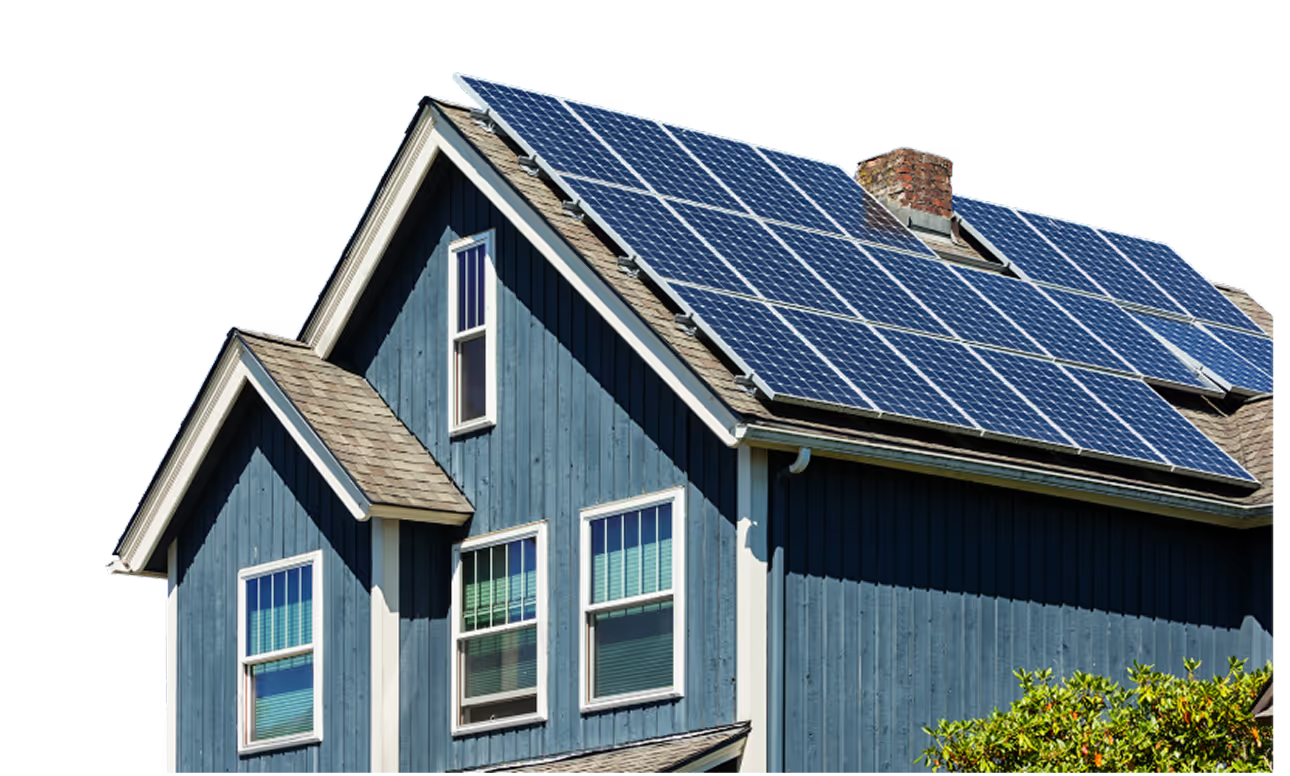
There are only two ways to bring a TNB bill down: use less, or generate your own. With solar energy, every kWh you self-consume is a kWh you don’t import, so AFA doesn’t affect it at all. Exported solar under the Solar ATAP scheme also earns you bill credits at RM0.27–0.37/kWh depending on your tier, though the real savings sit in self-consumption, not export.
Most homeowners size a solar system against their actual bill rather than paying upfront. Rent-to-Own plans start from RM0 upfront, with the fixed monthly payment typically landing below what the system saves though the exact gap depends on your roof, usage, and system size. If your usage is heavier in the evening, it's worth checking whether a battery actually pays back for your household.
For a deeper look at system sizing, costs, and what qualifies for Solar ATAP, see our complete homeowner's guide to Solar ATAP.

Rent-to-Own Solar. RM0 Upfront cost. Guaranteed Savings
Immediate ROI



Rent-to-Own Solar. RM0 Upfront cost. Guaranteed Savings
(10-Year RTO plan)
+ 10-Year Free Maintenance

Be part of The Solar Collective, where we share the latest updates, tips, and discussions on solar energy.

%20Price%20per%20Sq%20Ft.webp)
%20vs%20Assessment%20Tax%20(Cukai%20Pintu)%20Key%20Differences.webp)