Key Takeaways:
On RM25,000, rooftop solar that cuts your TNB bill by RM350 a month returns about 17% a year in savings, against 5.75 sen per unit from ASB for 2025 and an average of about 2.3% on a 12-month fixed deposit. If you reinvest the bill savings, solar gains around RM28,600 over 10 years against about RM18,700 from ASB. The catch is that solar spends your capital, while fixed deposits and ASB keep it withdrawable.
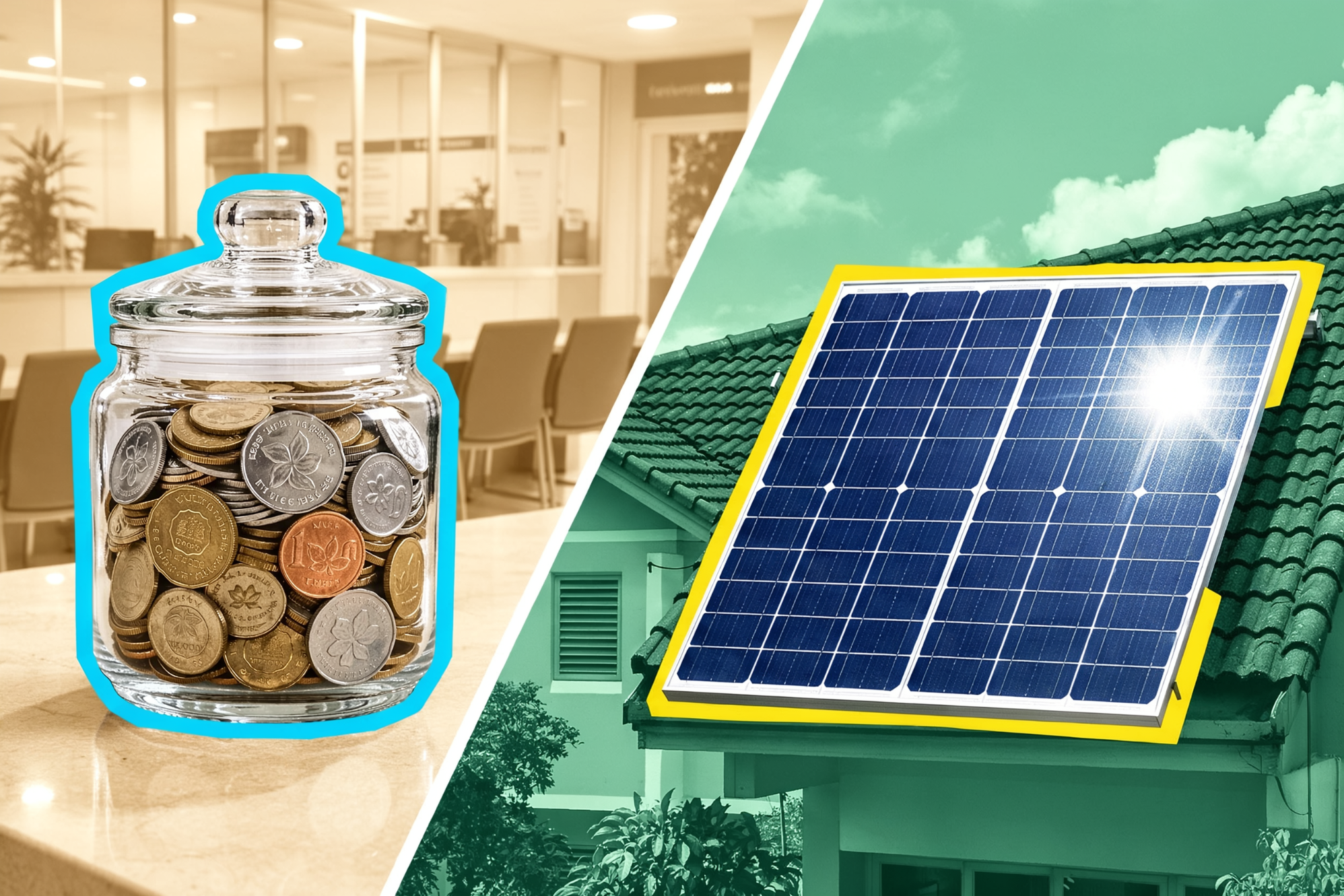
You have RM25,000 sitting in the bank. Leave it in a fixed deposit, move it into ASB, or put it on your roof?
Most comparisons stop at the headline rate, and on that measure solar wins easily. But solar works differently from a deposit: you spend the RM25,000 to get the savings, and you can't take it back out. That changes the maths more than most solar ads admit.
Below, we compare what the same RM25,000 earns in each over 10 and 25 years, the risks behind each return, and which one fits your situation.
Which Earns More: Solar, Fixed Deposit or ASB?
In the first year, solar earns the most by far: about RM4,200 in bill savings on RM25,000, against around RM1,440 from ASB and RM570 from a fixed deposit. Here's how the 3 compare on the same RM25,000:
| Option | Return used | Year 1 return | Gain after 10 years | Gain after 25 years |
|---|---|---|---|---|
| Fixed deposit | 2.29% a year | RM573 | RM6,352 | Not modelled |
| ASB | 5.75% a year | RM1,438 | RM18,726 | RM76,146 |
| Rooftop solar | RM350 a month in savings | RM4,200 | RM28,622 | RM187,596 |
FD rate is the 2025 average for Maybank's 12-month deposit and the ASB rate is the 5.75 sen per unit declared for FY2025, both as reported by Bernama, with returns reinvested. Solar uses the RM25,000 system saving RM350 a month from our payback guide, with 0.5% panel ageing a year and each year's savings reinvested at the ASB rate, to compare like for like; gain is the total minus the RM25,000 spent. Past returns don't guarantee future ones.
The comparison only holds if you treat the savings like ASB treats its dividends. ASB grows because its payouts are reinvested, and solar's lead depends on doing the same with the RM350 a month your bill drops by. If you spend the savings instead, solar's 10-year gain falls to about RM16,100, slightly behind ASB, and solar only edges ahead once the system keeps producing well past year 10.
Why Is Solar's Return Different From FD and ASB?
Solar is a spending decision that pays you back, not a deposit, so its return comes as lower bills while the original capital is used up. That has 3 knock-on effects:
- You can't withdraw it: money in a fixed deposit or ASB is there when you need it; money in panels is on your roof.
- Savings track your bill, not a rate: if TNB tariffs rise, solar savings rise with them. If your usage drops, so do your savings.
- The system ages: panels lose a little output each year, and an inverter usually needs replacing once during a 25-year life.
That's also why a solar "return" isn't taxable income: you're simply paying less for electricity. Our breakdown of your TNB bill before and after solar shows where the savings come from.
What Are the Risks of Each Option?
Each option trades return against safety and access in a different way:
| Factor | Fixed deposit | ASB | Rooftop solar |
|---|---|---|---|
| Capital | Kept, and protected by PIDM up to RM250,000 per bank | Kept, at a fixed RM1 unit price | Spent on the system |
| Access to money | At maturity, or early with lost interest | Any time | None; the value stays with your home |
| Return certainty | Fixed for the term | Declared yearly, not guaranteed | Depends on usage, tariffs and your roof |
| Who can invest | Anyone | Bumiputera only | Landed homeowners with a suitable roof |
ASB is only open to Bumiputera investors. Non-Bumiputera investors can consider other fixed-price ASNB funds such as ASM, which declare their own rates.
If you sell your home, the panels go with it, which our guide to selling a home with solar panels explains.
Which Should You Choose?
The best choice depends on what the money is for, and many homeowners end up using more than one:
- Emergency fund: keep it in a fixed deposit. Easy access beats a higher return when you need cash quickly.
- Long-term savings you might need: ASB, if you're eligible, gives a higher yearly return while keeping your capital available.
- Money you won't need, a high TNB bill and a home you'll stay in: solar earns the most over its life, especially if you plan to stay 7 years or more.
- You want solar savings without spending your savings: Rent-to-Own puts panels on your roof at RM 0 upfront, so your fixed deposit or ASB keeps earning.
The last option is worth a closer look. It lets the same RM25,000 stay in ASB while the bill savings start from month 1, which our solar financing comparison works through in detail.
For a deeper look at how quickly a cash purchase pays for itself, see our solar payback period guide for Malaysia.
Don't Choose Between Them If You Don't Have To
Solar earns the highest yearly return of the 3, and if you put the bill savings to work, it builds the most wealth over time. But it spends your capital, while ASB and fixed deposits keep your money intact and available.
You don't have to pick one. With GetSolar's Rent-to-Own plan, you start at RM 0 upfront with maintenance included, so your savings stay invested and your TNB bill still drops.
Check out our solar calculator or chat with the team on WhatsApp whenever you're ready.

Rent-to-Own Solar. RM0 Upfront cost. Guaranteed Savings
Immediate ROI



Rent-to-Own Solar. RM0 Upfront cost. Guaranteed Savings
(10-Year RTO plan)
+ 10-Year Free Maintenance

Be part of The Solar Collective, where we share the latest updates, tips, and discussions on solar energy.