Key Takeaways:
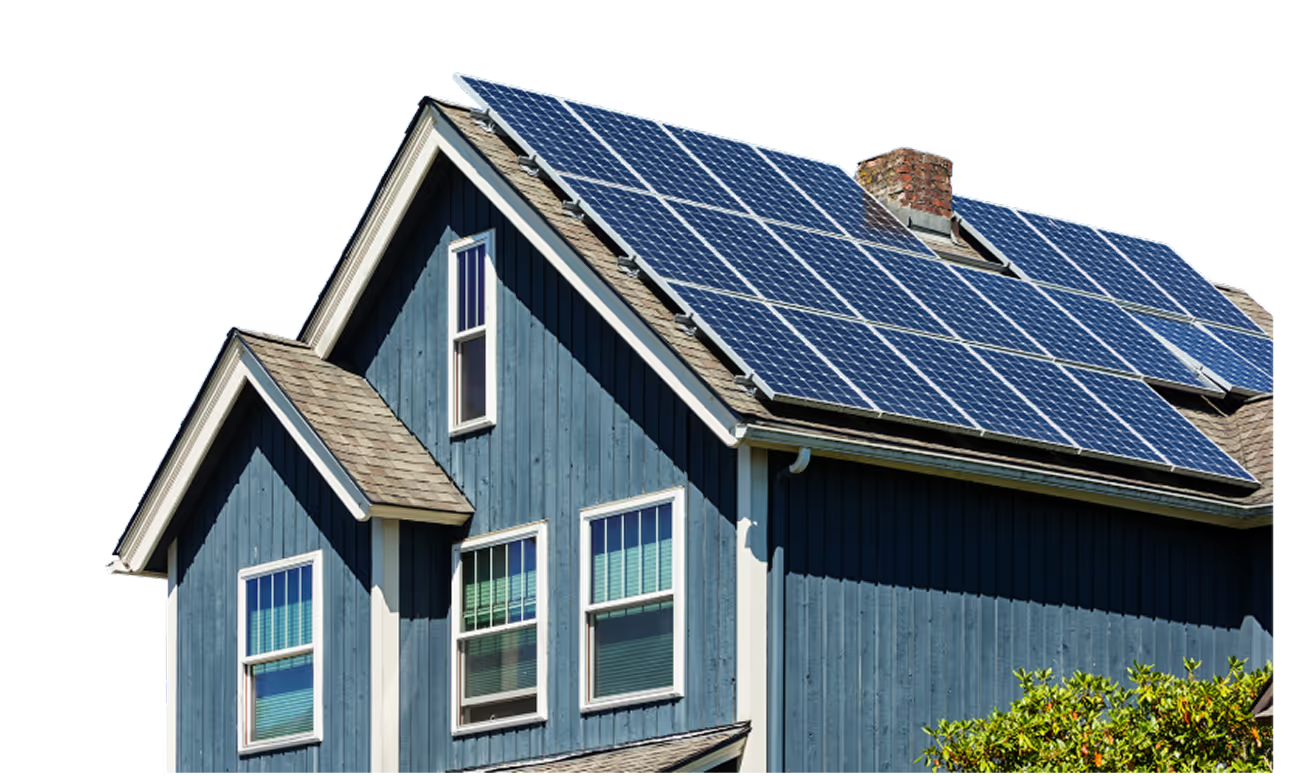
You can run your aircond with solar in Malaysia. However, the most cost-effective and reliable way to get a solar air cond setup in Malaysia is not by purchasing specialised "solar-powered air conditioner" units. Instead, pairing your existing inverter airconds with a rooftop solar PV system under Malaysia's Solar ATAP scheme is the best method.
If you're searching for a solar air cond setup in Malaysia, the number that actually decides your savings isn't the panel price, it's TNB's Automatic Fuel Adjustment (AFA), currently sitting at +3.67 sen/kWh for September 2026, the fifth consecutive surcharge month after nine months of rebates.
AFA applies only once you cross 600 kWh a month. Below that line, AFA, the RM10 retail charge and the 8% service tax are all waived. Cross it and all three activate at once.
For landed homes, aircond usage is typically what pushes consumption over that threshold.
This guide breaks down what your aircond actually costs under current tariffs, whether a dedicated solar powered air conditioner (sometimes searched as "solar AC") is worth buying, and how much rooftop solar takes off the bill.
What is a Solar Air Cond? (Dedicated Units vs. Rooftop Solar Pairing)
When searching for a solar air cond, solar AC, or solar powered air conditioner in Malaysia, you will find two main setups:
- Standalone Direct-DC / Hybrid Solar AC Units: Specialised units designed to plug directly into dedicated solar panels using Direct Current (DC).
- Standard Inverter Aircond + Rooftop Solar PV Pairing: Standard home airconds (Daikin, Panasonic, Acson, Midea, and the others covered in our guide to the top 7 aircond brands in Malaysia — link pending) powered through your distribution board from a central rooftop array.
Direct-DC solar powered air conditioner units sound convenient, but pairing standard high-efficiency inverter airconds with grid-tied rooftop solar wins for the overwhelming majority of homes.
Instead of locking yourself into niche solar AC hardware, a standard rooftop system lets you run whichever brand of aircond you prefer on free daytime solar.
Why Does Aircond Usage Drives Up TNB Bills in Malaysia?
In a landed home running three or more airconds for around 8 hours a day, cooling is typically the single largest line item in the electricity bill, often making the majority of total household usage.
Since 1 July 2025, TNB no longer bills domestic consumers on the old tiered block structure. Under the RP4 tariff, every domestic kWh is charged at a flat rate built from three components — 27.03 sen Energy + 4.55 sen Capacity + 12.85 sen Network = 44.43 sen/kWh up to 1,500 kWh/month, and 54.43 sen/kWh above it, as set out in TNB's residential pricing and tariff schedule. On top of that:
- AFA (Automatic Fuel Adjustment): a monthly variable surcharge or rebate, replacing the old six-monthly ICPT.
- Energy Efficiency Incentive (EEI): a rebate of up to 25 sen/kWh for lower usage, shrinking in bands as consumption rises.
- The 600 kWh cliff: at 600 kWh the RM10 retail charge, AFA and the 8% service tax are all waived. At 601 kWh every waiver ends at once, taking a bill of around RM215.98 to around RM258.11 for one extra kWh.
Running several AC units through the day is what typically carries a household past that threshold.
How Much Does It Cost to Run a Standard Aircond in Malaysia?
The following table breaks down typical power draw and the marginal electricity cost for common household airconds running 8 hours per day, using the current 44.43 sen/kWh base rate:
Figures are the marginal cost of running the aircond alone before AFA, EEI, KWTBB or SST, all of which apply at the whole-bill level rather than per appliance.
The gap between the inverter and non-inverter rows is the cheapest saving on this page, and we worked through when that upgrade actually pays for itself in our inverter vs non-inverter aircon comparison.
What Will Your Own Aircond Setup Cost?
The table above prices a single unit running 8 hours a day. Most homes run three or four, at different sizes.
Set the calculator below to your own setup. It factors in the rest of your household load to work out whether your aircond pushes you past the 600 kWh cliff. For a line-by-line breakdown of your statement, check out our TNB bill calculator instead.
As a reference point: two 1.5 HP inverter units running 8 hours a day, on top of a typical household load of 350 kWh, add around 504 kWh and RM336 to the bill, taking a typical TNB bill to roughly RM419 with a recommended system size near 7 kWp.
Why Do Daytime Cooling and Solar ATAP Work So Well Together?
Rooftop solar generation peaks between 10:00 AM and 3:30 PM, coinciding with the hottest hours of the day.
However, most Malaysian households still do the bulk of their cooling after dark rather than during peak solar hours. Your daytime runtime share is what decides your savings.
Peak solar generation: 10:00 AM – 3:30 PM
Peak daytime heat and aircond load: 11:00 AM – 4:00 PM
Overlapping window, roughly 5 hours a day.
What Solar ATAP Pays You for Running Your Aircond
Under Malaysia's Solar ATAP (Accelerated Transition Action Programme) framework, your home uses its own solar first and exports the surplus. Your aircond decides which of the two you are on.
- Cooling at 2:00 PM is free. Every unit your aircond draws while the panels are producing avoids the full 44.43 sen/kWh plus that month's AFA. On a 1.5 HP inverter, that means you’d save around 50 sen of cooling per hour.
- The same cooling at 9:00 PM costs 21 sen a unit more. Export that solar instead and you earn back the Energy Charge only, 27.03 sen/kWh up to 1,500 kWh a month. You then buy the night-time unit back at 48.10 sen.
- Shifting runtime beats adding panels. Three 1.5 HP units moved 4 hours a day from evening to afternoon saves around RM80 a month, on the same system size.
- Do not oversize for night cooling. Export credits are forfeited at the end of each billing month, so extra panels cannot bankroll overnight aircond usage.
Sources: SEDA Malaysia's Solar ATAP portal; TNB RP4 domestic tariff schedule.
How Much Solar Capacity Do You Need for Your Aircond Load?
To make sure your solar air cond system covers daytime cooling, match system capacity to the total wattage of the airconds running at the same time during daylight.
Rule of thumb: every 1.0 HP of inverter aircond running through the day needs roughly 1.2 kW to 1.5 kW of solar to cover that unit alone. The matrix below sizes for the whole house, so the totals run proportionally higher on smaller properties, where fridges, lighting and water heating make up a larger share of the load.
Check your supply phase before sizing anything. Solar ATAP caps domestic systems at 5 kW single-phase and 15 kW three-phase. These limits are set in kWac (inverter output), so a 5 kWac ceiling accommodates roughly 5.5 to 6.5 kWp of panels. Going above your cap requires a TNB Connection Confirmation Check, which carries a RM1,000 study fee.
Solar Capacity Sizing Matrix for Malaysian Homes
Payback ranges span the full cost and savings bands shown. The lower figure assumes best-case pricing with strong daytime self-consumption; the higher figure assumes the opposite. Sources: SEDA Solar ATAP Guidelines, TNB RP4 tariff schedule.
The RM3,000 Rebate That Shortens Every Payback Above
The recent SuRIA Home rebate pays domestic Solar ATAP customers RM600 per kWac up to a maximum of RM3,000, reached at 5 kWac. You must be a Malaysian citizen and must not have claimed a cash rebate under the earlier SolaRIS programme.
Most of the systems in the table above claim it in full, and the paybacks listed do not include it. Applications run from 1 June 2026 to 31 December 2026, or until the allocation is exhausted, on a first come, first served basis.
How Do You Cool Your Home at Night Without Solar?
Four strategies help you manage night-time cooling costs:
Strategy 1: Solar ATAP Credit Offset (Zero Hardware)
Export surplus daytime solar to the TNB grid for bill credits that offset night-time consumption. Partial cover only, and the credit expires monthly.
Strategy 2: Thermal Pre-Cooling ("Thermal Banking")
Cool rooms to 21°C–22°C between 1:00 PM and 4:30 PM on peak solar, then reset to 25°C at night. The chilled building mass lets the inverter compressor idle at 200–300 W.
Strategy 3: Battery Energy Storage Systems (BESS)
Lithium batteries of 10 kWh to 13.5 kWh store daytime surplus for overnight cooling, at meaningful extra capital cost.
Strategy 4: Inverter Upgrades
Modern inverter airconds cut overnight draw against a non-inverter, because the compressor modulates instead of cycling at full load.
Should You Upgrade Airconds First or Install Solar First?
Work it out from your current monthly TNB bill:
- Below RM200/month: upgrade the airconds first. Replacing non-inverter units with 5-star inverter models costs around RM1,500 to RM2,500 each and cuts consumption by 30% to 50%.
- RM200 to RM400/month: check the age of your AC units. If they are already inverters, you should consider going solar.
- Above RM400/month: install solar first. A high bill means more of your usage sits in the priciest part of the tariff, which is what solar displaces first.
- Airconds older than 7 years: do both together. Efficient units cut how much you need to generate; solar cuts what you pay for the rest.
If you're going Rent-to-Own, ignore the thresholds above.
Those breakpoints only apply if you're buying solar outright, where you need years of savings to recover the RM11,000-RM56,000 you spent upfront. Under Rent-to-Own there's no capital outlay to recover, so there's no payback period to wait out at all.
The only question that matters is whether your monthly RTO fee is lower than what solar removes from your bill. Check your RTO quote against the savings range for your property profile in the sizing table above. If the fee sits below that range, it's saving you money from month one, with no upfront cost and no multi-year wait to break even.
Action Checklist: How to Get the Most From a Solar Aircond Setup
Frequently Asked Questions
Can solar panels power an aircond without grid electricity?
Standard grid-tied solar systems require an active utility grid connection to function for safety reasons. To run a solar powered air conditioner during a power outage, you need a hybrid inverter paired with a battery backup system (BESS).
How many solar panels are needed for a 1.5 HP aircond in Malaysia?
A 1.5 HP inverter aircond draws around 1,050 Watts. Using 550W panels, you need 3 to 4 panels (1.65 kW to 2.2 kW) to cover that one unit during daylight. Whole-home sizing runs higher, which is why the Terrace (Small) profile above is sized at 3 kWp rather than 2 kWp, since the fridge, lighting and water heating draw on the same array.
Is a dedicated DC solar air conditioner better than a standard aircond paired with solar PV?
No. Dedicated DC solar air conditioners rely on proprietary hardware components that can be difficult to source or repair. Pairing standard 5-star inverter airconds with a household rooftop solar PV system offers best ROI and powers your whole house rather than just one appliance.
Your Aircond Isn't the Problem. The Rate You Pay to Run It Is.
We will never recommend that you reduce your aircond usage in our Malaysian weather. What you can change is what each unit costs.
A semi-D running four 1.5 HP inverter units spends around RM7,400 a year on aircond alone at current rates. Over ten years that is close to RM74,000 spent entirely on staying cool.
Rooftop solar does not reduce how much your aircond uses. It changes who you buy those units from, and at RM0 upfront it can cost less than the bill it replaces from the first month.
Check out our free solar calculator or chat with the team on WhatsApp whenever you're ready.

Rent-to-Own Solar. RM0 Upfront cost. Guaranteed Savings
Immediate ROI



Rent-to-Own Solar. RM0 Upfront cost. Guaranteed Savings
(10-Year RTO plan)
+ 10-Year Free Maintenance

Be part of The Solar Collective, where we share the latest updates, tips, and discussions on solar energy.


%20Price%20per%20Sq%20Ft.webp)
%20vs%20Assessment%20Tax%20(Cukai%20Pintu)%20Key%20Differences.webp)