Key Takeaways:
Single phase vs 3 phase comes down to wiring, voltage, and capacity. Single-phase runs 230V through 2 wires and covers most Malaysian homes comfortably, while three-phase runs 400V through 4 wires and splits your load across three separate lines. TNB advises an upgrade once your household load crosses 10kW or 50A, a line that a bigger solar system, an EV charger, or a third air-conditioning unit can push you past quickly.
Ask three different installers whether your home can handle a bigger solar system or an EV charger, and you'll likely get three different answers. The question on single phase vs 3 phase or single phase and three phase power, however you've seen it written really comes down to one thing: how many phases of electricity reach your consumer unit, and how much load each one can carry.
Most Malaysian homes run single-phase; larger bungalows and heavy-load homes run three-phase. In 2026, Solar ATAP capacity limits, EV chargers, and multi-split air-conditioning are pushing more homes past what single-phase can comfortably handle. Here's what differentiates the two, how to check yours, and when to upgrade.
What Is Single-Phase Power?
.webp)
Single-phase power is the standard electricity supply for most homes in Malaysia. TNB delivers it at 230V through two wires: one live and one neutral. That's enough current for typical household loads: lighting, fans, a fridge, a washing machine, and one or two air-conditioning units.
The limitation shows up once load increases. Since every appliance pulls current through the same two wires, there's a practical ceiling before the supply struggles. TNB advises upgrading from single-phase to three-phase once your household load crosses 10kW or 50A. As a rule of thumb, running three or more air-conditioners is usually the tipping point.
In short: single-phase comfortably covers ordinary household loads, but it has a hard ceiling once demand climbs.
What Is Three-Phase Power?

Three-phase power splits your electricity across three separate live wires instead of one, each offset from the others so current arrives in a steadier, more continuous flow. TNB supplies three-phase power at 400V through four wires: three live, one neutral.
Spreading the load across three lines means no single wire carries the full capacity, so three-phase supply comfortably handles bigger loads before anything trips. This is why larger bungalows, homes running heavier equipment, and properties with bigger solar systems or fast EV chargers typically run on three-phase.
In short: three-phase exists to carry load single-phase can't.
Single Phase vs 3 Phase: What's the Real Difference?
Sources: TNB myTNB Portal (2026)
The difference isn’t in the quality of the supply, but whether the supply can match your demand. A single-phase terrace with a fridge, some fans, and one air-conditioner rarely needs three-phase. A bungalow running four air-conditioners, a pool pump, and an EV charger usually does.In short: match your supply to your actual demand, not the other way around.
How Do I Know If My Home Is Single-Phase or Three-Phase?
In our site assessments, phase type is one of the first things we check, since it decides your solar sizing before anything else does.
There are two quick ways to check it yourself first:
Check your meter box: A single-phase meter has 2 incoming wires. A three-phase meter has 4, with more terminals and a larger casing.
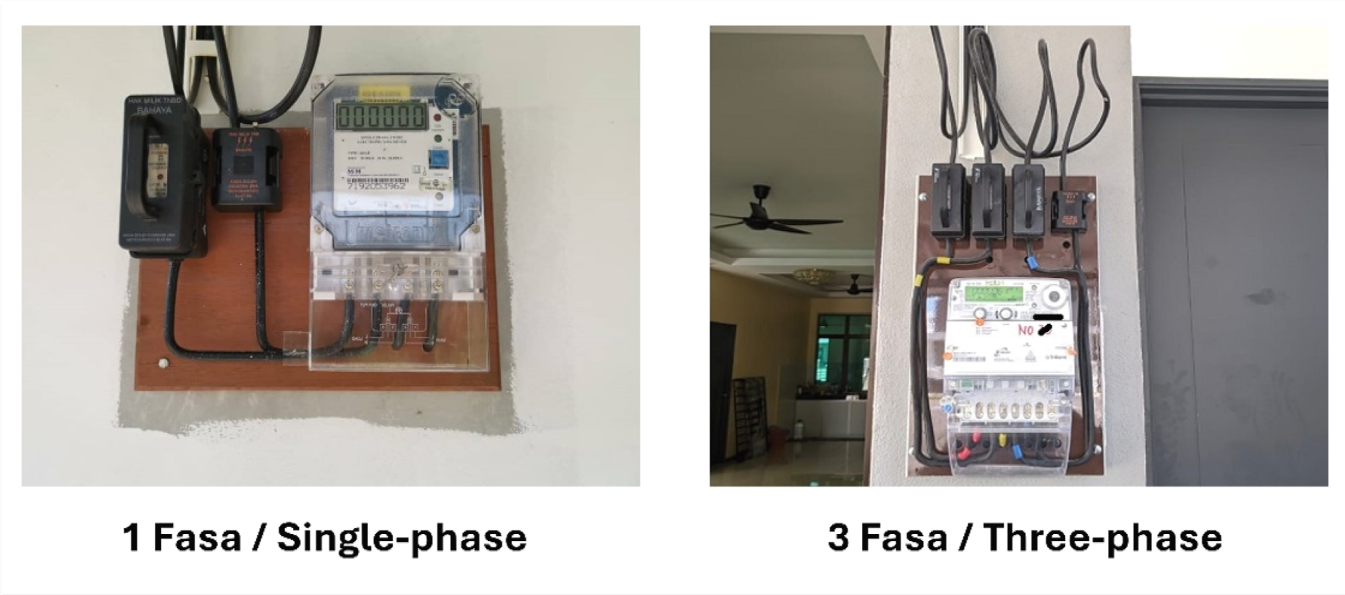
Check your TNB bill: Your bill will state your supply type: single-phase or three-phase, near the account details.
If you're planning a solar installation, GetSolar's team confirms your supply type during the site assessment as a standard step, alongside checking your available amperage (60A, 100A, or three-phase).
Can Your Single-Phase Supply Handle Solar or an EV Charger?
Often, yes, but there’s a limit. Under Solar ATAP, single-phase homes are capped at 5kWac of inverter capacity, while three-phase homes can go up to 15kWac. If you're planning a larger system, or pairing solar with a home EV charger, that limit matters:
Sources: SEDA Malaysia, Solar ATAP (2026)
A single-phase home running a modest 4–5kWac system for daytime household load plus light EV charging is usually fine. A home targeting an 8kWac+ system, or running a 22kW three-phase EV charger, will definitely require an upgrade first.
Single vs 3 Phase: Should You Upgrade?
If you're weighing single and three phase for a new build, or deciding whether your existing supply still fits your household, here's how to think about it:
Under 10kW / 50A load, no major additions planned: Stay on single-phase. There's no financial benefit to upgrading early.
Three or more air-conditioners, a pool pump, or a large solar system planned: Upgrading is worth pricing out and considering now.
An EV charger above 7kW, or more than one EV: Three-phase gives you the headroom for faster charging without maxing out your supply.
Upgrading is a long process so expect to allocate 4 to 8 weeks for TNB's approval and connection charges, on top of your electrician's rewiring work. Combining the upgrade with a planned solar installation usually makes more sense than doing it as a standalone job later, since your installer coordinates the site assessment and phase check either way. If you're upgrading standalone, you'll need a licensed electrician to handle the TNB application and rewiring. See our guide on how to find licensed three-phase conversion contractors in Malaysia if you’re going that route.
To get the full breakdown on how to convert your home from single-phase to three-phase, check out our article.
Frequently Asked Questions
What's the difference between single phase and three phase power?
Single-phase power runs at 230V through 2 wires and covers most Malaysian homes comfortably. Three-phase power runs at 400V through 4 wires, splitting your load across three separate lines instead of one.
Is single phase and three phase power the same thing?
No. They're two different types of electricity supply, distinguished by how many live wires carry the current and how much load each can handle. Single and three phase aren't interchangeable as your home is wired for one or the other, and switching requires a formal TNB upgrade.
Is three-phase power more expensive than single-phase?
Yes, upfront. TNB charges a connection fee for upgrading, and your electrician charges for the rewiring. Your ongoing electricity rate doesn't change based on phase type.
Can I install solar on a single-phase home?
Yes. Most single-phase Malaysian homes can run a solar system up to 5kWac under current Solar ATAP rules, which covers the majority of household needs.
Do I need three-phase power for an EV charger?
Not necessarily. A standard 7kW AC charger runs fine on single-phase. You'd only need three-phase for an 11–22kW charger or multiple EVs charging at once.
How long does upgrading from single phase to three phase take?
Most homeowners should expect 4 to 8 weeks from application to TNB activating the new supply, though this varies by area and existing infrastructure.
Match Your Supply to What You Actually Need
Most Malaysian landed homes will run fine on single-phase. The moment your air-conditioning count, EV charger, or solar ambitions cross TNB's 10kW/50A guidance, three-phase stops being optional and starts being what keeps your lights on without a trip to the fuse box.
Check out our free solar calculator to calculate your potential roof savings, or chat with the team on WhatsApp whenever you're ready.

Rent-to-Own Solar. RM0 Upfront cost. Guaranteed Savings
Immediate ROI



Rent-to-Own Solar. RM0 Upfront cost. Guaranteed Savings
(10-Year RTO plan)
+ 10-Year Free Maintenance

Be part of The Solar Collective, where we share the latest updates, tips, and discussions on solar energy.

%20Price%20per%20Sq%20Ft.webp)
%20vs%20Assessment%20Tax%20(Cukai%20Pintu)%20Key%20Differences.webp)