Key Takeaways:
Most landed homes in Malaysia need a 500–1,500 gallon tank, and polyethylene is the cheapest starting point while stainless steel lasts the longest. Rooftop tanks work for most homes, but ground tanks make more sense if you're also harvesting rainwater.
Does your water pressure drop every time you run two taps at once? Or worse, do you have no backup water whenever a supply disruption happens? A water tank fixes both problems, but you’ll face a wall of options: water storage ranging from 100 to 5,000 gallons, materials from polyethylene to stainless steel, and large price gaps between each option.
Getting this decision wrong is expensive. Undersize your tank and you're back to square one during the next dry spell. Oversize it and you're paying for capacity — and roof loading — you'll never use. This guide breaks down what a water tank actually does for your home, the materials available in Malaysia, how to size one correctly, and what you'll pay.
What Is a Water Tank and Do You Actually Need One?
A water tank stores water for your household to draw on when mains supply is disrupted, insufficient, or intermittent — common in newer housing developments still on a shared pipeline, and in areas prone to scheduled water cuts. It sits either on your roof, on the ground beside your house, or buried underground, feeding your plumbing system through gravity or a pump.
Not every home needs one. If you live in a well-established area with consistent water pressure, a tank is a "nice to have" rather than a necessity. But for landed homes in newer townships, homes with more than 4–5 occupants, or anyone who's experienced a scheduled supply cut, a tank moves from optional to practical fairly quickly.
One tank buys you time, not independence — most residential tanks hold enough for a day or two of normal use, not a week-long outage.
What Types of Water Tanks Are Available in Malaysia?
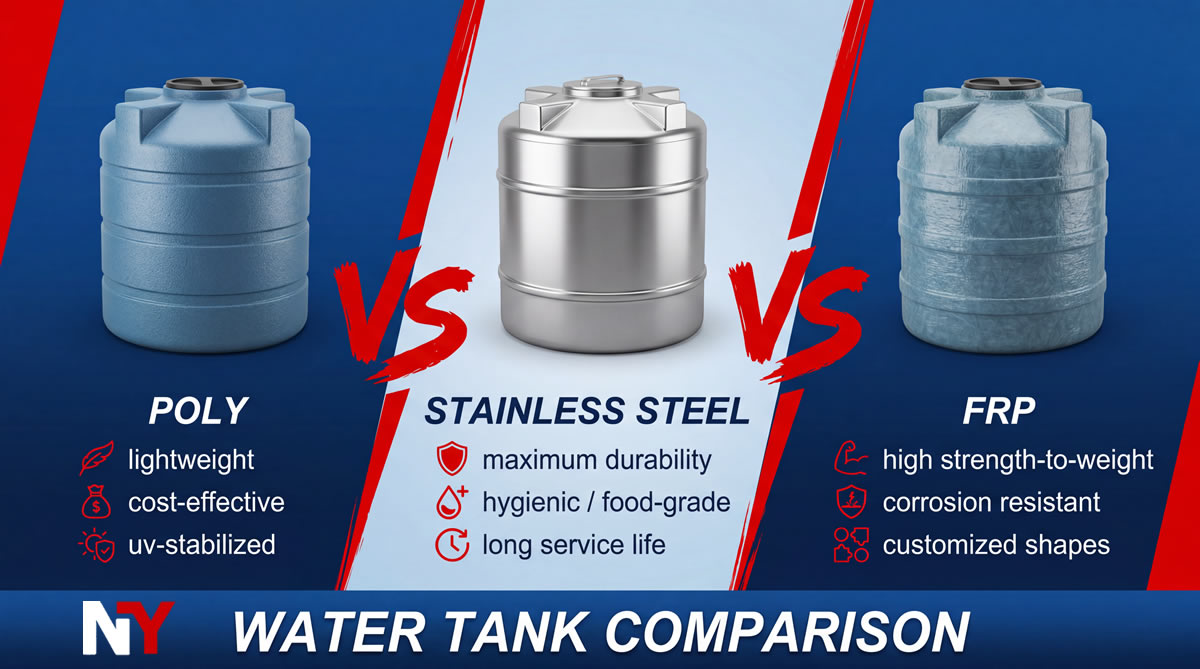
Three materials dominate the Malaysian residential water storage tank market, and each suits a different budget and use case.
- Polyethylene (poly) tanks: The most common choice for Malaysian homes — lightweight, corrosion-proof, and the cheapest option upfront. Best for general household use where cost matters more than longevity.
- FRP (fibreglass-reinforced plastic) tanks: A step up in durability, often used where structural strength matters more than a standard poly tank can offer, such as ground-mounted tanks carrying larger volumes.
- Stainless steel tanks: The premium option — corrosion-resistant, doesn't leach into stored water, and holds up longest under Malaysia's heat and humidity, but costs noticeably more than poly or FRP.
If you're deciding specifically between stainless steel and poly/FRP, our full comparison of stainless steel vs poly and FRP water tanks (link pending — article not yet published) breaks down the cost-versus-lifespan trade-off in more detail. If you've already got a King Kong tank on your shortlist, we've also reviewed pricing and specs for King Kong water tanks (link pending — article not yet published) separately.
Poly wins on price, stainless wins on lifespan — most homeowners land somewhere between the two based on budget.
What Size Water Tank Do You Need for Your Home?
Tank size should match your household's daily water consumption, not the size of your house. A rough rule: each person uses around 150–200 litres a day for typical household activities.
Based on general plumbing industry sizing guidance (150-200 litres per person/day). Adjust upward if your household's actual usage runs higher than average.
Buffer your estimate rather than cutting it fine. A tank sized exactly to daily use runs dry the moment you skip a top-up cycle — most homeowners add 20–30% headroom on top of the baseline in the table above.
Rooftop, Ground or Underground: Where Should Your Tank Go?
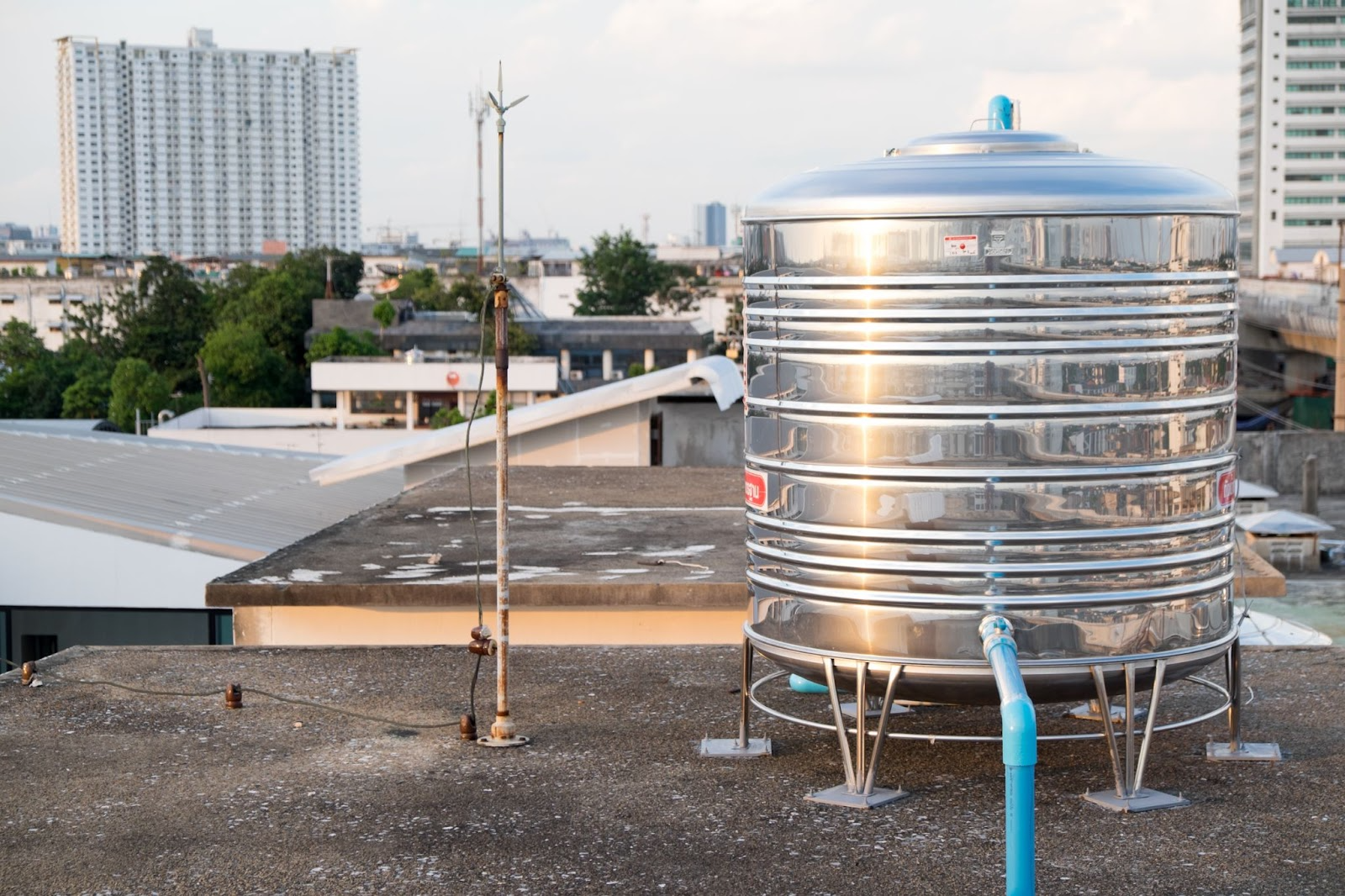
Placement affects both cost and practicality:
- Rooftop tanks: The default for most landed homes — gravity feeds your plumbing without a pump, saving on running costs. The trade-off is roof load capacity: a full 1,000-gallon tank weighs close to 4 tonnes, so your roof structure needs to support that safely.
- Ground-level tanks: Easier to install and maintain, no roof loading concerns, but you'll likely need a pump to maintain water pressure — adding to running costs and another component that can fail.
- Underground tanks: Best for homes short on space, and popular for larger-capacity rainwater harvesting setups. Installation costs more upfront due to excavation, but you free up usable land space.
From the field: Roof load capacity isn't a hypothetical for us, it's something GetSolar's installation team checks on every rooftop solar assessment before a single panel goes up. The same load calculation applies if you're adding a water tank to your roof. If you're planning booth solar panels and a rooftop tank, get your roof's total load budget checked once, not twice — our guide on roof leaks and structural checks before solar installation covers what to look for.
Rooftop tanks are cheapest to run; ground and underground tanks are easier to install but need a pump.
Can a Water Tank Double as a Rainwater Harvesting System?
Yes, and rain water harvesting tanks are becoming more common in Malaysia as households look to cut water bills and reduce dependence on mains supply during dry spells. A rainwater harvesting tank collects runoff from your roof, filters it, and stores it for non-potable use.
Under SPAN's Uniform Technical Guidelines for Water Reticulation and Plumbing, rainwater harvesting systems in Malaysia are meant for non-potable purposes only — general washing and gardening, not drinking water — and tanks must be clearly labelled accordingly. This matters when you're sizing and plumbing the system: a rainwater harvesting tank runs as a separate line from your mains-fed potable tank, not a replacement for it.
Rainwater harvesting cuts your water bill, but it supplements your main tank rather than replacing it.
How Much Does a Water Tank Cost in Malaysia?
Pricing depends heavily on material and capacity. As a general guide:
Pricing collected from Malaysian tank suppliers and retailers, August 2026. Confirm current pricing with your supplier before budgeting.
Installation, piping, and any pump add on top of the tank price itself — for rooftop tanks, factor in RM200–RM500 for professional installation on most landed homes.
Which Water Tank Brand Should You Choose?
There's no single "best" brand — the right choice depends on your budget, capacity needs, and whether you're prioritising cost or longevity. King Kong, Weida, and Deluxe are among the most recognised names in the Malaysian market, each competing largely on price within the poly and FRP categories.
Frequently Asked Questions
What is the best water tank for home use?
For most landed homes, a polyethylene tank in the 800–1,500 gallon range covers typical household needs at the lowest cost. Upgrade to stainless steel if longevity matters more than upfront price.
How much does a 500 gallon water tank cost in Malaysia?
Expect around RM300–RM600 for polyethylene, RM500–RM900 for FRP, and RM1,500–RM2,500 for stainless steel, before installation.
What is the best water tank in Malaysia?
There's no universal "best" — polyethylene suits budget-conscious buyers, while stainless steel suits homeowners prioritising durability and water quality over cost.
Do I need a rainwater harvesting tank if I already have a water tank?
They serve different purposes. Your main tank stores potable mains water; a rainwater harvesting tank is a separate, non-potable supply for washing and gardening use.
Choosing the Tank That Actually Fits Your Home
The right water tank isn't the biggest or the most expensive one — it's the one sized to how your household actually uses water, placed where your roof or land can support it. Get the sizing and material right, and a tank quietly does its job for a decade or more without another thought.
If you're already thinking about cutting utility costs at home, water efficiency pairs naturally with solar. Check out our free solar calculator to calculate your potential roof savings, or chat with the team on WhatsApp whenever you're ready.

Rent-to-Own Solar. RM0 Upfront cost. Guaranteed Savings
Immediate ROI



Rent-to-Own Solar. RM0 Upfront cost. Guaranteed Savings
(10-Year RTO plan)
+ 10-Year Free Maintenance

Be part of The Solar Collective, where we share the latest updates, tips, and discussions on solar energy.


%20Price%20per%20Sq%20Ft.webp)
%20vs%20Assessment%20Tax%20(Cukai%20Pintu)%20Key%20Differences.webp)