
Malaysia is entering a new chapter in its renewable energy journey. The long-standing Net Energy Metering (NEM) scheme, which has helped thousands of households reduce their electricity bills, has officially ended. In its place, the government will introduce a new programme called the Solar Accelerated Transition Action Programme (Solar ATAP), launching on 1 January 2026.
For many Malaysians, NEM has was familiar and reassuring. It allowed homeowners to offset electricity usage with the solar energy they generated (read more about NEM Rakyat 3.0 here). With Solar ATAP on the horizon, a common question remains:
Will solar still be worth it without NEM?
The short answer is yes and for many homeowners, the new structure may offer more value than initially expected.
This article explains what Solar ATAP is, why NEM is being replaced, and what the changes mean if you're considering solar for your home. Short on time? Read our Quick Guide to Solar ATAP for a simplified overview.
What is Solar ATAP?
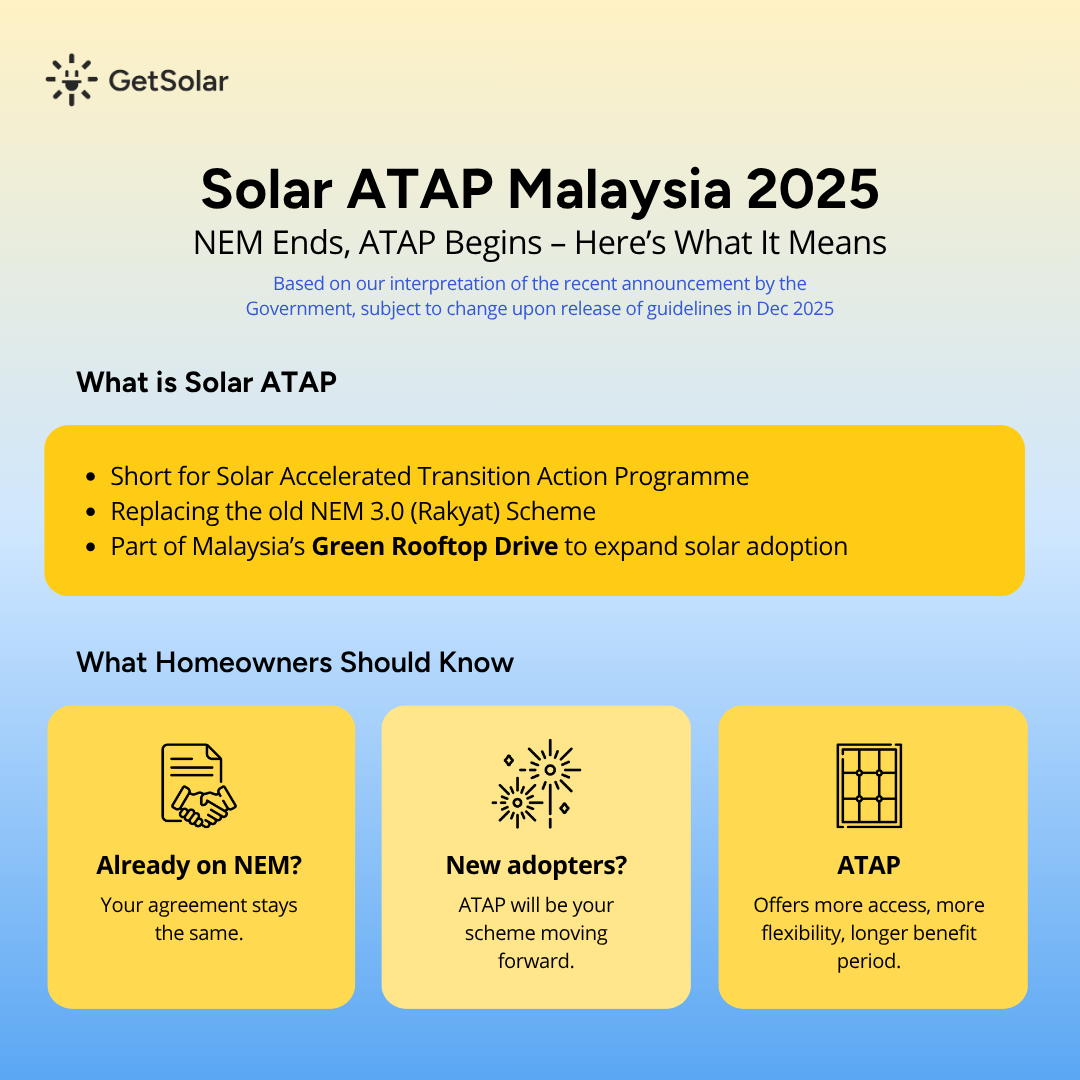
Solar ATAP stands for the Solar Accelerated Transition Action Programme. It is Malaysia’s new rooftop solar initiative designed to take over from the NEM scheme.
Introduced under the government’s Green Rooftop Drive, Solar ATAP was officially launched on 1 January 2026, following the closure of NEM in June 2025 (The Edge).
The goal remains familiar:
- Make rooftop solar accessible and affordable
- Support households and businesses in reducing electricity costs
- Accelerate Malaysia’s transition to clean energy
Ever wondered how much a complete solar system would cost for your specific roof layout? We've got you covered with our FREE solar calculator.
The biggest change is in how exported solar energy is valued and who benefits most.
Why Replace NEM With ATAP?
The Net Energy Metering (NEM 3.0) scheme was effective, but it came with limitations.
Participation was restricted by fixed quotas, and once those quotas were filled, new applicants were locked out. This created uncertainty for homeowners who were interested in solar but missed the application window.
Solar ATAP was introduced to address these issues.
Unlike NEM, ATAP is designed to be:
- More flexible, with no fixed national quota
- More inclusive, potentially covering additional sectors such as agriculture
- Better aligned with Malaysia’s long-term energy strategy
As part of the Green Rooftop Drive, ATAP supports Malaysia's ambition to reach 70% renewable energy capacity by 2050, as highlighted by Bernama.
In short, ATAP is not just a replacement but it is a structural upgrade to make solar adoption more sustainable and scalable.
What Changes Under Solar ATAP?
While final guidelines will only be published on the 31 December 2025, several confirmed changes already set ATAP apart from NEM.
Export Credits: The Biggest Shift
Under NEM 3.0, exported solar energy was credited almost 1-to-1 against your TNB bill.
Under Solar ATAP, the approach is more nuanced:
For Residential Homeowners
Exported solar energy will be credited at retail-linked energy rates, not wholesale prices. Expected export values are:
~ RM 0.27 per kWh for households using up to 1,500 kWh/month
~ RM 0.37 per kWh for households using more than 1,500 kWh/month
This is significantly higher than earlier expectations of wholesale-only pricing (~RM 0.20/kWh), translating into better overall savings for many homes.
For Commercial & Non-Domestic Users
~ Export credits will be based on the System Marginal Price (SMP)
~ SMP is a market-based electricity price that fluctuates roughly every 30 minutes
System Size Flexibility
Under ATAP, solar systems can be installed up to 100% of your maximum demand.
This allows homeowners to:
- Size systems more accurately to real usage
- Avoid under-installing due to outdated caps
- Optimise self-consumption and export value together
Broader Eligibility
Unlike NEM’s tightly defined categories, ATAP is expected to:
- Remove rigid quota limits
- Extend participation to more user groups over time
The intention is clear: encourage solar adoption, not restrict it.
What Does This Mean for Homeowners?
If you are already under NEM, there is nothing to worry about. Your existing agreement continues under the same terms.
For new adopters:
- Solar ATAP becomes the default scheme from 1 January 2026
- Exported solar now has clear, meaningful value, especially for residential users
The key takeaway is simple:
Self-consumption remains the best way to maximise savings but exporting excess solar is now far more rewarding than initially expected.
Households with higher electricity usage stand to benefit the most under ATAP's residential export structure.
Is Now Still a Good Time to Go Solar?
Yes — depending on how your household uses electricity.
If you:
- Use air-conditioning, appliances, or work from home during the day
- Want to reduce exposure to rising TNB tariffs
- Prefer starting savings immediately
Solar already makes sense through self-consumption alone.
Adding a battery can further extend savings into the evening, while Rent-to-Own (RTO) plans remove upfront cost barriers entirely — with maintenance and warranties included.
If you're deciding between an upfront, loan, or rent-to-own plan to finance your solar system, feel free to check out our dedicated article here.
For homeowners mainly focused on export credits, waiting for ATAP may be an option. But for many families, going solar earlier simply means more months of savings.
Frequently Asked Questions About Solar ATAP
What happens if I already have NEM 3.0?
Nothing changes. Your NEM agreement remains valid and continues under the same terms.
When does Solar ATAP start?
Solar ATAP launches on 1 January 2026, with registration and guidelines readt on Energy Commission and SEDA Malaysia platforms by 31 December 2025.
How are export credits calculated under ATAP?
Residential users receive retail-linked export rates (~RM 0.27 or RM 0.37 per kWh) depending on consumption. Commercial users receive credits based on System Marginal Price (SMP).
Is Solar ATAP better or worse than NEM 3.0?
NEM offered predictability, while ATAP offers greater access, flexibility, and realistic long-term value. For many homeowners, total savings remain strong — especially with proper system sizing.
Should I wait for ATAP before installing solar?
If you have high daytime usage, solar can already reduce bills today. Batteries and RTO plans make early adoption even more compelling.
The Road Ahead With Solar ATAP
Solar ATAP marks the next phase of Malaysia’s clean energy transition.
By replacing NEM with a more flexible and scalable framework — and by offering higher-than-expected residential export rates — ATAP ensures solar remains a practical, financially sensible choice for homeowners.
Solar isn’t going away. It’s evolving.
Want to see how Solar ATAP could work for your home?
- Try our Solar Savings Calculator for a free estimate
- Or chat with us to explore our RM0 upfront Rent-to-Own solar plans

Rent-to-Own Solar. RM0 Upfront cost. Guaranteed Savings
Immediate ROI



Rent-to-Own Solar. RM0 Upfront cost. Guaranteed Savings
(10-Year RTO plan)
+ 10-Year Free Maintenance

Be part of The Solar Collective, where we share the latest updates, tips, and discussions on solar energy.