[Updated, September 2026]
Key Takeaways:
One REC represents 1 MWh of clean electricity your system has generated, and you sell it separately from the power itself. GetSolar's flat rate is currently S$12/MWh, paid out twice a year. On a typical landed home system that's a modest annual top-up rather than a second income, so treat RECs as a bonus on top of your bill savings.
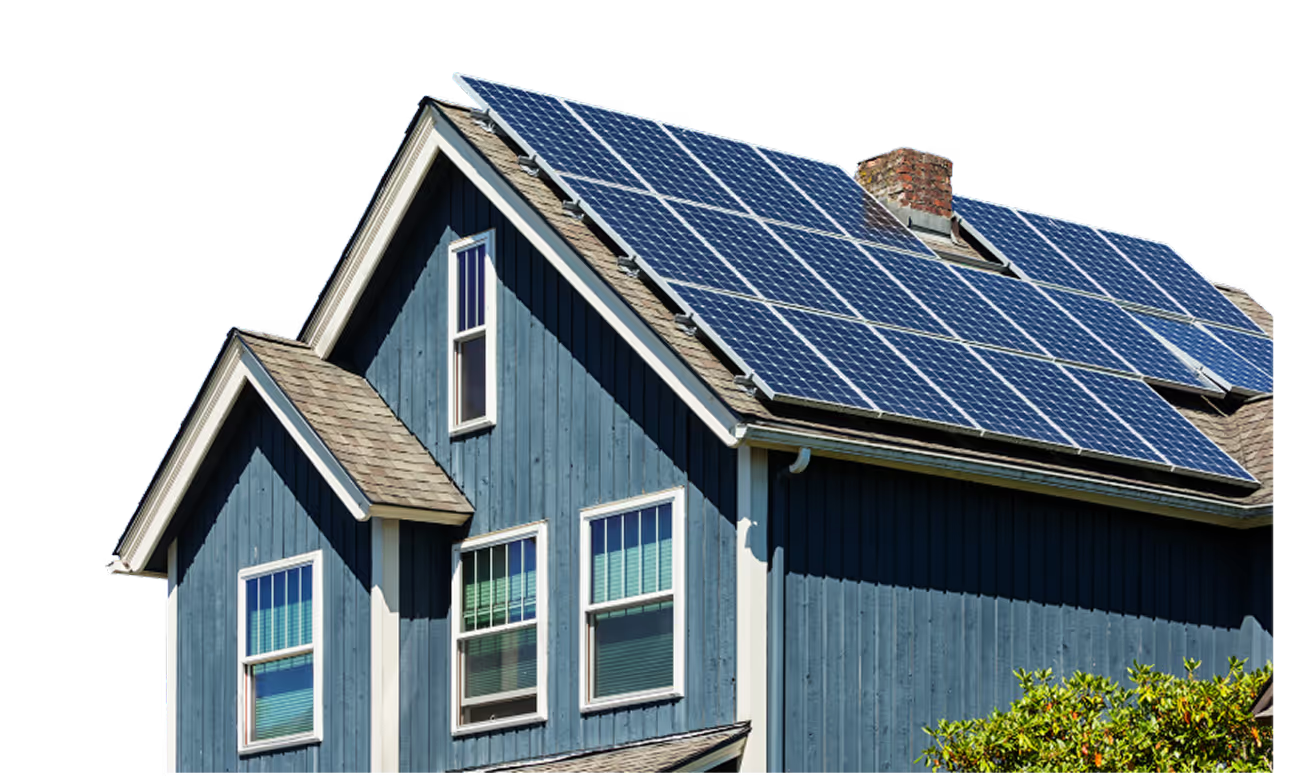
Solar is booming in Singapore. National projects like the floating solar farm at Tengeh Reservoir show the country is doubling down on renewables. If you already have panels on your roof, you might wonder what else your system can earn beyond monthly electricity savings. The answer is Renewable Energy Certificates (RECs).
What is a Renewable Energy Certificate (REC)?
RECs are tradable digital assets that represent the clean energy attributes of electricity generated from a renewable source, such as your rooftop solar system. Every time your panels produce 1 megawatt-hour (MWh) of electricity, you earn 1 REC. You can then sell that certificate, which gives you a second line of income on top of your utility bill savings.
Selling a REC is not the same as selling green electricity. A REC only represents the clean energy attribute — the power itself still flows as normal, and your bill is unaffected. It works on a similar principle to carbon credits, which are also traded. To sell RECs, you first need to own a renewable generation source. In Singapore that almost always means a solar panel system.
The REC certifies that you own the clean energy attribute and that your system generated 1 MWh of clean electricity within a specific year, also called a "vintage" (the same term the wine trade uses).
I-REC or TIGR: Which Registry Issues Your RECs?
Two registries handle almost all RECs in Southeast Asia, and both are recognised by RE100, CDP and the GHG Protocol. Your certificates carry equal weight with corporate buyers either way.
- I-REC (International REC Standard): the larger registry globally. In Singapore the issuer is the Green Certificate Company.
- TIGR (Tradable Instruments for Global Renewables): run by APX, which acts as both registry and issuer. As of 2023, Singapore leaned towards TIGR, with roughly 1.43 million TIGR certificates issued against 0.18 million I-RECs though I-REC issuance in Singapore has grown sharply since, so this split shouldn't be read as the current market share.
Singapore also has its own quality framework, SS 673: Code of Practice for Renewable Energy Certificates, introduced in 2021 to standardise how RECs are measured, reported and verified.
You don't need to pick. We handle registry selection and account setup as part of the programme. Our guide to selling RECs covers the registration mechanics if you want the detail.
Why Do Companies Buy RECs?

RECs are bought mainly by companies with sustainability or net zero targets tied to their energy use. Natural gas accounted for 93.1% of Singapore's fuel mix in the first half of 2025, down from 94.0% across 2024. To offset grid consumption against a net zero target, a company buys the equivalent number of RECs in megawatt-hours.
Most buyers simply lack the roof space to generate enough clean energy themselves. When a company purchases RECs, it is paying for the clean electrons that other solar systems injected into the same grid.
The same principles as carbon offsets apply. RECs must be verifiable, quantifiable, not double-counted and not claimed by another entity. Buyers using RECs against a sustainability target must retire or cancel them in their own name after purchase, so the certificates can't be traded again.
How Much Is a REC Actually Worth?
GetSolar's flat rate is currently S$12/MWh, fixed for the length of your contract. Because 1 REC equals 1 MWh, your annual earnings track your system size directly.
Assumes 1,150 kWh/kWp/year.
So consider a REC as a bonus on top of your solar savings. On a 10 kWp system it covers a couple of months of standing charges. The bill savings from the panels themselves remain the main financial case for solar.
Open-market REC prices move with demand and supply and have trended down since 2024. Most trades happen over-the-counter, so pricing is rarely transparent. We break down current pricing in our guide to REC prices in Singapore.
A flat rate is a trade-off, not a guarantee of the better deal. You give up any chance of catching a higher spot price in exchange for knowing exactly what you'll be paid, twice a year, for the length of your contract. If you'd rather track the market and accept the swings, the Revenue Share Plan below does that instead.
GetSolar’s RECs Programme: Two Simple Ways to Earn
We handle registration, verification, platform fees, reporting and payouts. You generate the clean energy and we help you turn it into cash.
Flat Rate Plan
For homeowners who want predictable earnings. You get a fixed S**$12/MWh**, locked in for a contract term of up to 5 years, with payouts twice a year.
Revenue Share Plan
For owners comfortable with market movement who want the upside. You earn a percentage of each REC's sale price and keep the majority; we take a small cut to cover platform fees and reporting. Better suited to larger systems where the volume justifies the variability.
Either way, payouts land twice a year and there are no out-of-pocket costs to you.
Selling RECs In Singapore
Doing it yourself is the hard part. Trading RECs in Singapore is hands-on and carries costs that catch people out (revenue-grade metering, registry account fees and annual maintenance charges). Our step-by-step guide to selling RECs in Singapore walks through each stage and what it costs.
For most residential systems, those fees eat the returns before you see them. That's the gap our programme fills. Let GetSolar sell your RECs for you and we absorb the registration and transaction costs. You authorise us once, then collect the payouts.
Buying rather than selling? If you're sourcing RECs for a corporate sustainability target, start with our guide to buying RECs in Singapore.
Frequently Asked Questions About RECs in Singapore
How much does a REC sell for in Singapore?
GetSolar's flat rate is S$12/MWh, fixed for your contract term. Open-market prices vary and are traded over-the-counter, so they aren't publicly quoted. Regional prices have softened since 2024.
How many RECs will my home solar system generate a year?
One REC per 1 MWh generated. A 10 kWp landed home system produces around 11,500 kWh a year, which is roughly 11.5 RECs, or about $138 at the flat rate.
Are RECs the same as carbon credits?
No. RECs cover Scope 2 emissions from purchased electricity. Carbon credits offset emissions from fuel combustion and industrial processes. See our comparison of carbon credits and RECs.
Does selling my RECs increase my electricity bill?
No. A REC represents the clean energy attribute only. The electricity your panels generate still offsets your consumption exactly as before, and your SP Group bill is unaffected.
Can I sell RECs without going through a provider?
Yes, but you'll need revenue-grade metering, a registry account and annual maintenance fees. For most residential systems those costs exceed the REC income.
How often do REC payouts happen?
Twice a year under both GetSolar plans, with no out-of-pocket cost to you.
Worth Doing, Worth Knowing the Numbers
RECs won't transform how your solar works. At S$12/MWh they're a modest annual top-up on a system that's already paying for itself through bill savings. What they do offer is money you'd otherwise leave on the table, for close to zero effort once you've authorised us.
If you already have solar panels, there's no reason not to register. If you're still deciding on solar, make the decision on the bill savings and treat RECs as a bonus.
Curious what your system would earn? Chat with us on WhatsApp and we'll work it out from your system size.

Rent-to-Own Solar for Business with Guaranteed Performance
Immediate ROI


Rent-to-Own Solar. $0 Upfront cost. Guaranteed Savings
(10-Year RTO plan)
+ 10-Year Free Maintenance

Be part of The Solar Collective, where we share the latest updates, tips, and discussions on solar energy.